
Lead generation vs demand generation
Demand generation makes the right buyers aware of you; lead generation turns that interest into named people to call. On a tight budget, start with lead generation.
Tools our VAs use for this


The difference in brief
One line on each
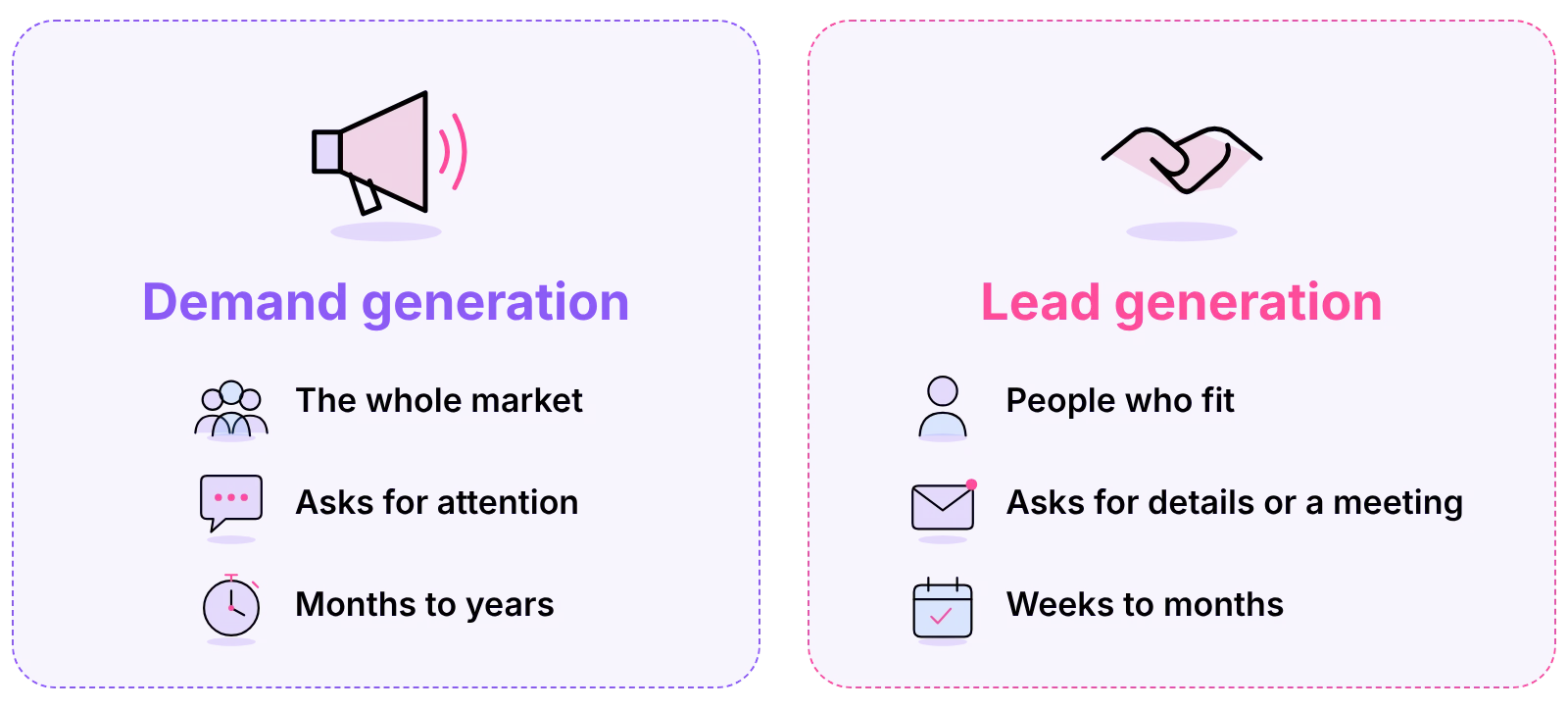
Demand generation makes the right people aware of a problem and of you as a way to solve it, usually without asking for anything in return. Its partner, lead generation, turns that interest, or a well-researched list, into named people you can speak to and pass to whoever sells.
Which to prioritise first
For a small business with a tight budget, start with lead generation: it produces conversations sooner and is easier to measure. Add demand generation steadily alongside it, because the leads get easier to win once the market already knows who you are.
On this page
What demand generation is
Demand generation is the work of creating and growing interest in what you sell across your market. It does not have an official definition, and businesses draw its edges differently, but the common thread is educating buyers before they are ready to buy.
Demand generation goals
Its goals are awareness, trust and preference: that when a buyer feels the problem you solve, they already know your name and think of you first. It works over months and years.
Demand generation examples
These are illustrations of the kind of work involved:
- Useful guides, articles and videos that answer buyers' questions, free to read with no form.
- A podcast, a newsletter or a regular LinkedIn post on your area of expertise.
- Speaking at an industry event or contributing to a trade publication.
- Free tools, such as a calculator or a checklist.
What lead generation is
Lead generation turns interest into named contacts and conversations. Our guide to what is lead generation covers it in full.
Lead generation goals
Its goal is a steady flow of qualified leads and booked meetings. It works over weeks and months.
Lead generation examples
These are illustrations of the kind of work involved:
- A contact or quote form on a page built for one service.
- A guide offered in exchange for an email address.
- Personal outreach by email, LinkedIn or phone to businesses that fit your ideal customer.
- Following up event contacts and booking calls.
Side-by-side comparison
Goal, audience, tactics, metrics and timeframe
| Aspect | Demand generation | Lead generation |
|---|---|---|
| Goal | Awareness, trust and preference | Named contacts and booked conversations |
| Audience | The whole market you could serve | People and businesses who fit your ideal customer |
| Typical tactics | Free content, social posts, podcasts, events, PR | Forms, gated guides, outreach, follow-up, appointment setting |
| Asks the buyer for | Attention | Contact details or a meeting |
| Main metrics | Reach, engagement, branded search, direct enquiries | Leads, qualified leads, meetings, cost per lead |
| Timeframe | Months to years | Weeks to months |
| Usually owned by | Marketing | Marketing and sales together |
How the two work together
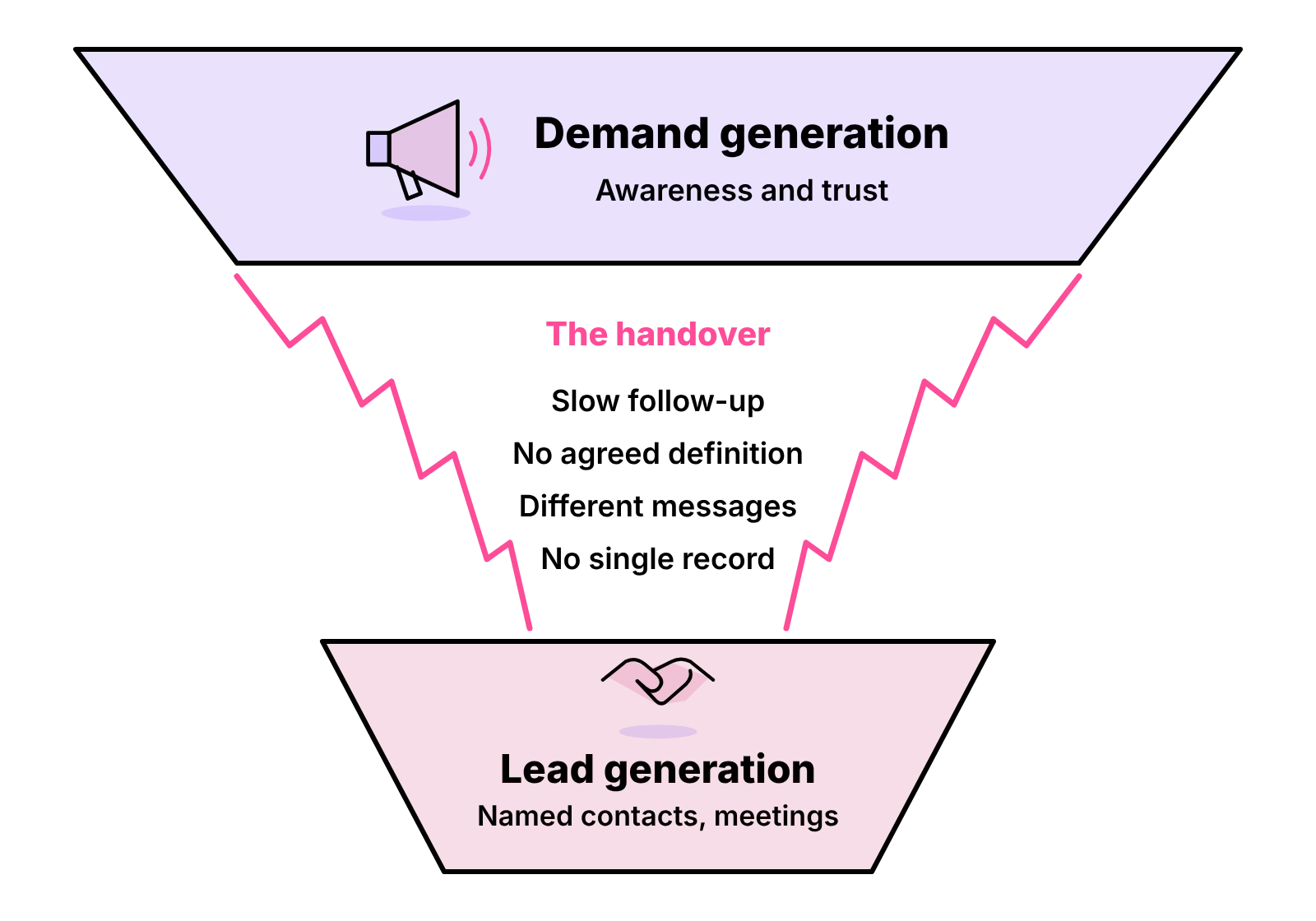
Demand generation fills the top of the funnel; lead generation turns that interest into conversations. The best results come when the two share a picture of the ideal customer and the same message. Inbound and outbound lead generation sit within this picture, and our guide to inbound vs outbound lead generation covers that split.
Where the handover breaks
The biggest mistake in lead generation usually happens at the handover. Common breaks:
- Slow follow-up. An enquiry from someone who read your content waits days for a reply.
- No agreed definition. Marketing passes on anything with an email address; sales ignores most of it. Our guide on how to qualify leads shows how to agree one.
- Different messages. Your content promises one thing and your outreach says another.
- No record. Leads are spread across inboxes and phones, with no single CRM.
How to measure each
Measure lead generation with leads, qualified leads, meetings booked and cost per lead, by channel. If someone runs it for you, ask for those figures every week; how a VA reports lead generation results shows what to expect.
Measuring demand without form fills
Demand generation is harder to measure, because much of its effect never touches a form. Look for indirect signs over months: more people searching for your business by name, more direct visits to your website, more enquiries that say "I've been reading your posts", and a shorter path from first call to sale. Add "How did you hear about us?" to your enquiry form and ask it on every first call.
UK rules for lead and demand generation
Lead generation and demand generation are both legal in the UK, provided you follow the rules on marketing and personal data. This is general information, not legal advice.
PECR, TPS and UK GDPR in brief
The ICO's business-to-business marketing guidance, which it says is under review following the Data (Use and Access) Act, sets out the main points. The PECR rules on marketing emails do not apply to companies, but they do apply to sole traders. Live marketing calls must be screened against the TPS and CTPS registers, under regulation 21 of PECR. Named business contacts are personal data, so UK GDPR applies. The ICO's guidance on collecting information and generating leads adds that lead generation using bought or enriched data must be fair, lawful and transparent, with proportionate due diligence on where the data came from.
Demand generation agencies and costs
A demand generation agency plans and runs the awareness side for you: content, social media, events, PR and often paid campaigns, with reporting on reach and engagement. Some also run lead generation; many hand the leads they create back to your team to follow up. We could not find an official or independent source for what such agencies typically charge, so this guide does not quote a figure. Ask any agency how it prices, what it will report, and who follows up the interest it creates. If LinkedIn is the channel you are pricing, LinkedIn lead generation cost in the UK sets out the costs.
Which to prioritise and when
Whether to prioritise lead or demand generation depends on your stage and budget: on a tight budget, start with lead generation and give demand generation a small, fixed amount of time each week.

On a tight budget
Most guides on this topic are written for businesses with a marketing team. If you have little money and less time, start where the return is quickest and easiest to see: lead generation aimed at a narrow ideal customer, with personal outreach and fast follow-up of every enquiry. Put a small, fixed amount of time each week into demand generation, such as one useful article or post, so that it builds while the outreach pays the bills. Our guide to lead generation for small business has practical ideas for that first stage.
Do you still need lead generation if demand generation works?
Usually, yes. Strong demand generation means more people come to you, but someone still has to reply, qualify, follow up and book the meeting. Without that, demand turns into enquiries that wait too long, and buyers who were interested go elsewhere.
Using a virtual assistant for lead and demand work
Tasks a VA handles: lists, outreach and appointment setting
A dedicated lead generation VA works the lead side every day: building and cleaning lists, personal outreach, following up enquiries quickly, booking meetings and keeping the CRM current. That is the part of the handover that most often breaks. At Ant Assist your VA is one dedicated person, never shared, who works full time from our own managed office in Cairo, where they are recruited, managed and supervised; they are not freelancers and not AI. The service is UK-managed and works UK business hours, 9am to 5pm Monday to Friday. Rates start at £5 per hour on the introductory rate for the first 6 months on the Entry tier; after the promotion, lead generation on the Entry tier is £5.50 per hour full time (£880 a month) or £6.50 per hour part time (£520 a month). The calculator compares that with an in-house hire.
Tasks that stay with marketing
Ant Assist supplies the lead side only; brand-level demand programmes are outside the service. Your positioning, your content strategy and your brand stay with you or your marketing team, and your VA follows up the interest they create.



Questions about lead and demand generation
Didn't find your answer? Browse more common questions in the Help Center.
Turn interest into booked meetings.
One dedicated lead generation VA, from £5 per hour. Book a call.