
Lead generation for small business
Know who you serve, keep two or three channels going every week and reply fast: slow replies often lose the enquiry to whoever answers first.
Tools our VAs use for this


Good lead generation for small business comes down to a clear picture of who you serve, two or three channels you can keep up every week, and a fast, personal reply to every enquiry. Referrals, a useful website with local search visibility and direct outreach usually pay back first. Keep the offer and the selling yourself, and hand over the repeatable hours of research, outreach, follow-up and CRM updates once they crowd out paid work. Those hours are what a lead generation virtual assistant takes on.
On this page
What lead generation means for a small business
Lead generation is the work of finding people or businesses who could buy from you and getting them into a conversation. Our guide to what is lead generation covers the basics in full. For a small business, it means a routine you can keep up alongside the day job.
What a lead is
A lead is a person who has shown interest in what you sell, or who fits your ideal customer closely enough to contact. Someone who fills in your contact form, rings for a quote, replies to an email or asks for a brochure is a lead. A name on a list you have never contacted is a prospect. The distinction matters because the number you track should be leads.
Why it matters without a marketing team
Many small businesses grow on word of mouth until it slows down. Without a routine, new work arrives in bursts: a busy month, then a quiet one, then a scramble. A simple, regular habit of finding and following up leads smooths that out, and it gives you choice over which work you take on.
Low-budget strategies
Start with the strategies that use what you already have: customers, a website and your own time. Pick two or three and run them every week before adding more. How inbound and outbound methods compare is set out in our guide to inbound vs outbound lead generation.
Referrals and your own network
Your existing customers are the cheapest source of new ones. Ask for a referral at the moment a customer thanks you, and make it easy by offering to write the introduction. Stay in touch with past customers, suppliers and local businesses that serve the same people you do. A partner who sends you work is worth a monthly coffee.
Local SEO and a useful website
Claim and complete your business profile on the main maps and search listings, with accurate hours, services and photos, and ask happy customers to leave reviews. Make sure your website says plainly what you do, where you work and how to get in touch, with a contact form and a phone number on every page. Add a page for each main service and each area you cover.
Content, guest posts and podcasts
Answer the questions your customers ask you every week, on your own site: what it costs, how long it takes, how to choose. Offer to write a useful article for a trade body, a local business group or a supplier's newsletter, or appear on a podcast your customers listen to. One good piece a month, kept up, beats a burst of posts followed by silence. Content like this is demand work, and lead generation vs demand generation explained sets out the difference.
Cold outreach
Contacting businesses that fit your ideal customer, by email, LinkedIn or phone, can bring leads within weeks. Keep each message short and specific to the person, follow up a few times, and stop when asked. Check the UK rules below first. Our LinkedIn outreach page shows how this runs on LinkedIn, and the appointment setting page covers turning replies into booked meetings. For more outreach routines ranked by effort, see B2B lead generation tips for small teams.
Online advertising
Paid search and social ads can bring enquiries quickly, but you pay from the first click. Start small, target the area and customer you serve best, send the click to a page built for that offer, and stop any ad that does not produce enquiries. Add ads once your website converts the visitors it already has.
Tools worth paying for
CRM and capture tools
The one tool almost every small business benefits from is a simple CRM: a single place where every lead, its source, the last contact and the next step are recorded. Add a contact form that feeds it, and a shared calendar link so leads can book a call without back-and-forth emails.

How to choose
Choose the tool you will actually open every day. Check that it works with your email and calendar, that you can export your data, and that the free or entry plan covers your current volume. Avoid paying for features you will not use for a year.
Speed to lead and common mistakes
The five-minute rule
The "five-minute rule" is a common sales rule of thumb: reply to a new online enquiry within minutes, while the person is still at their screen and thinking about you. We could not find a primary source for the exact figure, so treat it as a target. The underlying point does have research behind it: a study published in the Harvard Business Review, "The Short Life of Online Sales Leads" by Oldroyd, McElheran and Elkington, found that most companies respond too slowly to online enquiries (abstract). For a small business, a fast, personal reply is one of the cheapest advantages you have.
The biggest mistakes
- No follow-up. Most leads do not buy on the first contact. A lead you never contact again is a lead you paid for and threw away.
- Slow replies. An enquiry left until the end of the week has often gone to whoever answered first.
- No record. Leads kept in your head, your inbox and your phone get lost. Put every one in the CRM.
- Too many channels at once. Six half-run channels produce less than two run properly every week.
- Chasing everyone. Not every lead fits. Our guide on how to qualify leads shows how to decide quickly which to pursue.
What a small business spends on leads
How much to pay
We could not find an official or independent source for what UK small businesses typically spend on lead generation, so this guide does not quote a market figure. Work out what you can afford from your own numbers: take the value of a typical new customer to you over a year, decide what share of that you would pay to win one, then compare that with the cost of each route. Keep a running cost per lead and cost per new customer, by channel, so you can drop what does not pay.
Paying for hours or for leads
The cheapest routes cost only your time: referrals, your business listings and reviews, answering customer questions on your website, and personal outreach. When your own time is the limit, paying for hours is often cheaper than paying for leads. A dedicated Ant Assist VA starts at £5 per hour on the introductory rate, for the first 6 months on the Entry tier, 3 months on Mid and 1 month on Expert. After the promotion, lead generation on the Entry tier is £5.50 per hour full time (£880 a month for 160 hours) or £6.50 per hour part time (£520 a month for 80 hours). Our virtual assistant cost UK guide covers VA costs more widely, and the calculator compares a VA with an in-house hire for your hours.
UK rules for outreach
UK rules apply to your own outreach too: screen numbers against the TPS and CTPS before marketing calls, follow the PECR email rules for sole traders and some partnerships, and check any bought list. The points below follow the ICO's business-to-business marketing guidance, which the ICO says is under review following the Data (Use and Access) Act, so check the page before you rely on it. This is general information, not legal advice.
Calls and the TPS and CTPS
A business that makes live marketing calls to other businesses must screen the numbers against both the Telephone Preference Service (TPS) and the Corporate Telephone Preference Service (CTPS) before it calls.
Emails to companies and sole traders
According to the ICO, the PECR rules on marketing emails do not apply to companies, but they do apply to sole traders and some partnerships, so many small-business customers fall under the stricter rules.
Bought data lists
If you buy a list, the ICO's guidance on collecting information and generating leads says you must do proportionate checks and due diligence before you get the data, and that you cannot rely on the seller's assurances alone. Ask the seller for evidence of how the data was collected and screened, including how recently it was checked against the TPS, and screen it again yourself before you call, because the business making the calls must screen against the TPS and CTPS.
What to do in-house and what to outsource
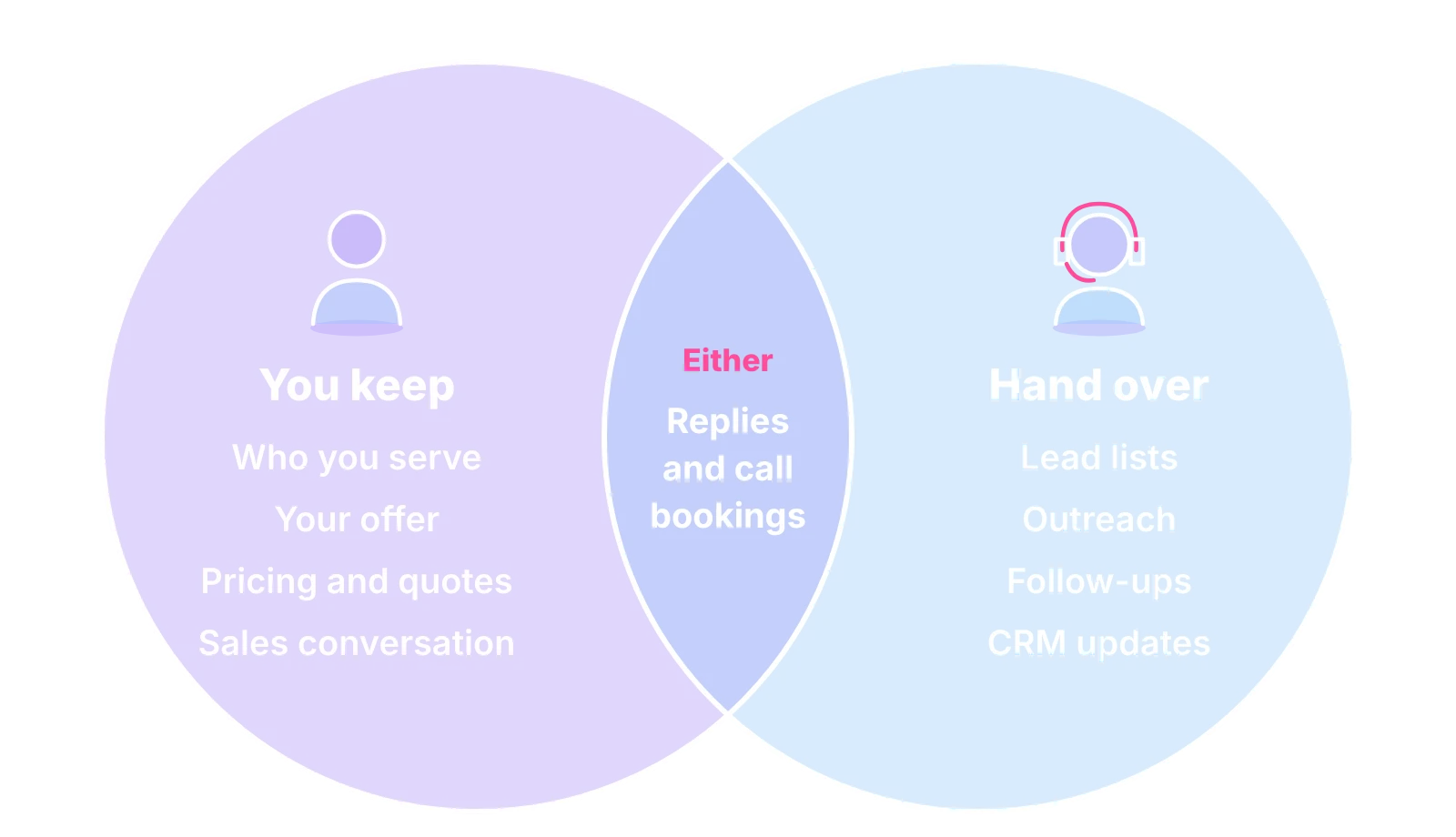
In small business lead generation, keep decisions on who you serve, pricing and the sales conversation in-house, and hand over list building, first-touch outreach, follow-ups and CRM updates. Most guides on this topic stop at the list of ideas. The harder question for an owner is which parts to keep.
| Task | Keep in-house | Hand over |
|---|---|---|
| Deciding who you serve and what you offer | Yes | No |
| Pricing and quotes | Yes | No |
| The sales conversation | Yes | No |
| Researching and building lead lists | No | Yes |
| First-touch outreach and follow-ups | No | Yes |
| Replying to enquiries and booking calls | Either | Yes, with clear rules |
| Updating the CRM | No | Yes |
An agency runs campaigns with its own process and reporting, and usually suits a business with a marketing budget. A freelancer can be good value for a defined project, though availability varies. A dedicated VA works your routine every day, in your own tools, under your direction. Our guide on how to hire a VA for lead generation walks through that choice.
Getting lead generation help from a virtual assistant
Tasks to hand over
A lead generation VA takes on the repeatable hours: researching and building lists, first-touch outreach and follow-ups, LinkedIn activity, replying to enquiries within the rules you set, booking calls into your diary and keeping the CRM current. At Ant Assist your VA is one dedicated person, never shared, who works full time from our own managed office in Cairo, where they are recruited, managed and supervised; they are not freelancers and not AI. The service is UK-managed and works UK business hours, 9am to 5pm Monday to Friday, from 20 hours a week up to a full 40-hour VA. If the fit is wrong, we replace the VA without restart cost.
Tasks to keep
You keep the offer, the pricing and the sales conversation. Your VA works in your accounts through password managers, under NDAs and data-processing agreements, and you can revoke access at any time. You get a regular report of what was done and what it produced; how a VA reports lead generation results shows what to expect.


Small business lead generation questions
Didn't find your answer? Browse more common questions in the Help Center.
Get your evenings back from prospecting.
One dedicated lead generation VA, from £5 per hour. Book a call.