
Lead list building virtual assistant: what good looks like
A good lead list is built to your ideal customer profile, verified, and carries a reason on every record. Without weekly CRM upkeep, it decays within a month.
Tools our VAs use for this


A good lead list is built from a written ideal customer profile, sourced from LinkedIn, industry databases and your existing CRM, verified before it is used and entered in a format your outreach tools and your CRM can both read. Good CRM hygiene is a weekly rhythm: contacts updated, activities logged, deals moved between stages, duplicates removed.
Both are checked by sampling, not by trust: you review the targeting criteria up front and a sample of records each week, and you refine the profile together from what the campaign returns. A dedicated VA from Ant Assist does this from £5 per hour on the entry rate. List building is core work for a lead generation virtual assistant.
On this page
Lead lists and CRM data explained
List building is the research half of lead generation: finding the people who match the profile of the customers you already win, and recording who they are, where they work, why they fit and how to reach them. CRM data is the record-keeping half: keeping the pipeline accurate as those people are contacted, replied to, booked, lost or won. The two are one job, because a list that is built well and then dumped into a CRM nobody maintains is a list that decays in a month. Outreach itself, the sequences, the calls and the appointment setting virtual assistant work that follows, sits on top of this foundation and is only as good as it.
What a good lead list looks like
A good lead list is built from a written ideal customer profile, drawn from more than one source, verified before use and formatted for your tools, with the reason on every record. It starts with a profile, not a search. Before any research, your ideal customer profile is written down: industry, size, geography, role, the trigger that makes someone a buyer now and the disqualifiers that make them a waste of a sequence. You review and approve it. Your VA only researches and contacts prospects who match it.
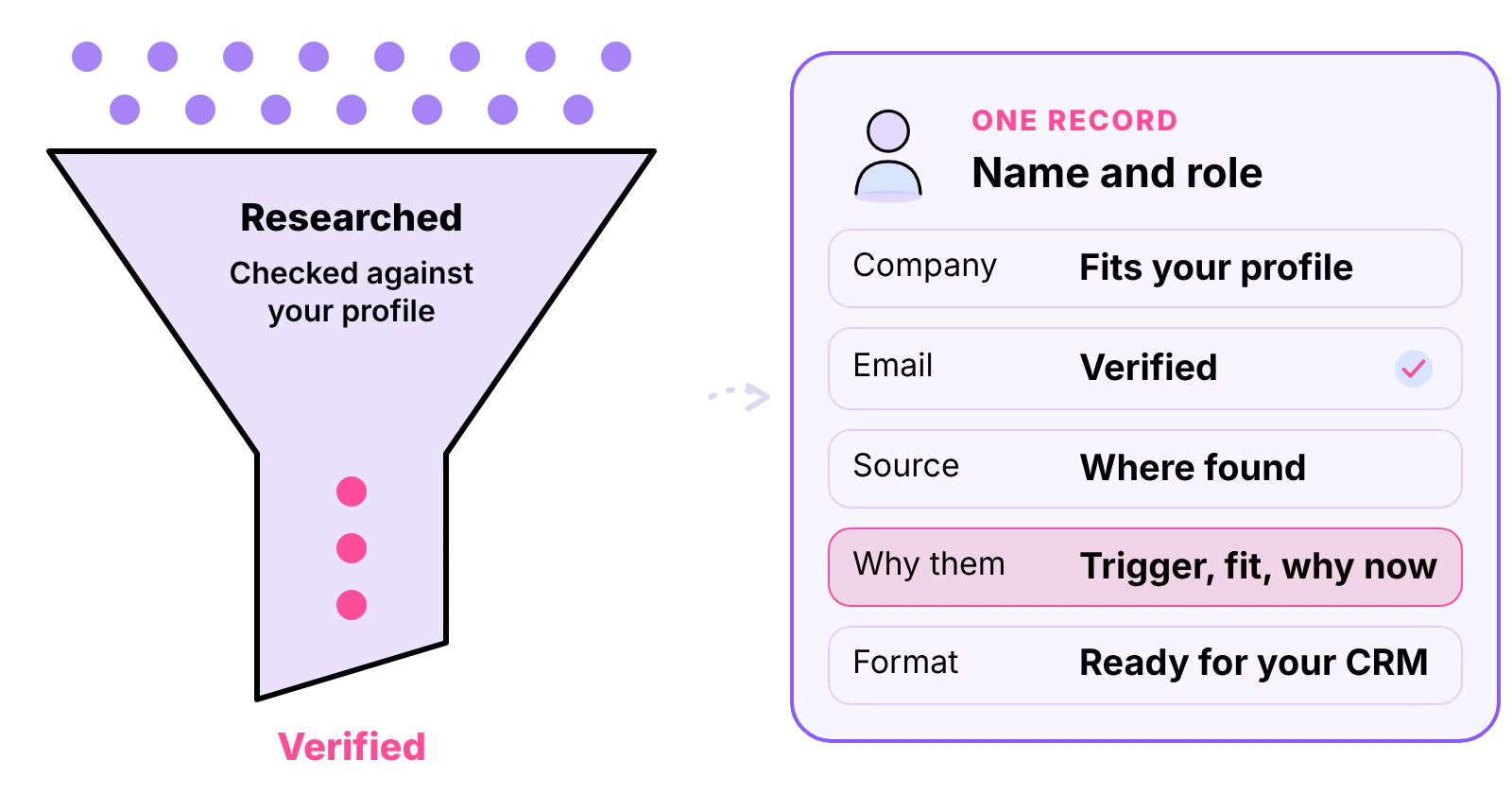
It is sourced from more than one place. LinkedIn and Sales Navigator for the people, industry databases for the companies, your own CRM for the accounts you have touched before and the lost deals worth a second look. A list built from a single source has a single source's gaps.
Every record carries the reason it is on the list. Not just a name and an email, but the fit against the profile in a field of its own: the trigger, the role, the note that tells the person writing the sequence why this prospect and why now.
It is verified before it is used. Emails checked with a verification tool such as Hunter.io, roles confirmed against the current profile, companies checked for the disqualifiers. The list that reaches your sequence tool is smaller than the list that was researched, and that is the point.
It is formatted for the tools that will use it. The same fields, in the same order, that your CRM and your outreach platform expect, so an import takes minutes and creates no duplicates.
Weekly CRM hygiene tasks
CRM hygiene means your VA keeps your pipeline accurate by updating contact details, logging activities, moving deals between stages and removing duplicates. In practice that is a rhythm.
Daily: every reply, call and meeting logged against the right contact; new leads from the list entered with their source; bounced or dead contacts marked, not deleted.
Weekly: deals moved to the stage they are actually at, not the one they were left in; duplicates merged; contacts who changed jobs updated; the follow-up list for lead nurturing rebuilt from what went quiet.
Monthly: a cleanup pass on the whole database: stale stages, empty fields, the imports that never got tagged, and a short note to you on what the pipeline looks like now and what it looked like a month ago.
If you do not have a CRM yet, that is a normal starting point: your VA can set up a basic one during onboarding, HubSpot's free tier is a popular choice, define the pipeline stages, import what you have and own it from day one.

Checking list and data quality
List building and CRM work fail silently, so the checks are built into the routine rather than left to a quarterly panic.
Targeting review before research starts. You approve the profile and the sources. A list built against an unapproved profile is wasted hours.
A sample every week. Ten records from the week's list, read against the profile: do they fit, is the reason recorded, do the emails verify. Ten records from the CRM: are the stages right, are the activities logged. If the sample fails, the batch is reworked before it goes into a sequence.
The campaign as the final check. Response rates by segment tell you which parts of the profile are right. You refine the targeting together from what comes back, which is why the profile is a living document and not a brief written once. Which motion to feed first is covered in inbound vs outbound lead generation for UK SMEs.
A weekly line from your VA. Records researched, verified, entered; duplicates removed; stages moved; anything in the data that looks wrong and needs your call. Read it; a report nobody reads stops being written. Before you appoint anyone, how to hire a VA for lead generation sets out what to test and ask.
Lead list building costs
A managed lead generation VA from Ant Assist starts at £5 per hour on the entry rate: the first 6 months on the Entry tier, 3 months on Mid, 1 month on Expert. After the promotion, the lead generation rate card applies: £5.50 per hour full time on the Entry tier (160 hours a month, £880) or £6.50 per hour part time (80 hours a month, £520), with Mid at £6.33 and Expert at £6.88 per hour full time for assistants with longer experience. There are no platform fees on top, and the rate includes the assistant's time, our office facilities in Cairo, and the supervision and management that keep quality up. Your CRM and prospecting tools are yours and stay in your name.

Hours set the price, and the list sets the hours: a narrow profile in one market is part-time work; several segments, several sources and a CRM that has not been cleaned in a year is a full-time role for the first months. For the comparison against a UK employee, line by line, read how much a virtual assistant costs in the UK or put your own hours into the calculator.
What the £5/hour entry rate includes
- Dedicated VA, never shared
- UK-hour aligned support
- Management and supervision included
- Recruitment and onboarding included
- Office infrastructure included
- VA replacement available
- No NI, pension, or holiday costs
- 3-month probation, no penalty to leave
List building with a dedicated VA
List building and CRM hygiene are the foundation of every lead generation motion, and the tasks most often left to whoever has a spare hour. A dedicated VA gives them an owner: one named person, on your hours, working in your tools under your brand, with a UK team supervising quality. From the same foundation the same VA can run the outreach, the LinkedIn prospecting and the booking, or hand a verified list to the team that runs your outsourced cold calling UK campaign. That wider work is our outsourced lead generation service. If the fit is wrong, we replace the VA and carry the handover, with no re-recruitment and no restart from zero.



Questions about list building and CRM data
Didn't find your answer? Browse more common questions in the Help Center.
Build the list. Keep the CRM clean.
One dedicated lead generation VA, from £5 per hour. Book a free 15-minute call.