
What is appointment setting?
Appointment setting is booking sales meetings with qualified prospects on a seller's behalf, so the people who close deals talk to buyers instead of chasing them.
Tools our VAs use for this


Appointment setting is booking sales meetings with qualified prospects on behalf of a salesperson or business owner. The setter does the outreach, the follow-up and the qualifying questions, then puts the meeting in the seller's calendar with notes attached. In B2B it is usually outbound: calling and emailing businesses that match an agreed profile. The people who close deals then spend their time talking to buyers instead of chasing them. If you would rather not set appointments yourself, a dedicated lead generation assistant can take it on.
On this page
What appointment setting means
Appointment setting defined
Most sales processes have three stages: find people who might buy, start a conversation, and close. Appointment setting is the middle stage. The setter works a list, handles the first "not now" and "send me something", and stops once a real meeting is booked. Closing stays with you.
To see appointment setting run by a dedicated person for a UK business, our appointment setting service page sets out the role as we deliver it.
What do appointment setters do?
- Research and check each contact before any outreach
- Call, email and message on LinkedIn in a planned sequence
- Follow up with prospects who showed interest but did not commit
- Ask the qualifying questions you agree, and record the answers
- Book the meeting, send the invitation and a reminder, and rebook any that are missed
- Log every touch in the CRM so the pipeline stays accurate
Types of appointment setting
- B2B books meetings with decision-makers in other businesses. Sales cycles are longer and each contact needs more research.
- B2C books consultations with consumers. Different UK rules apply to contacting individuals, so treat it as its own discipline.
- Outbound means the setter starts the contact; inbound means the setter turns existing enquiries into booked calls. Our guide to inbound vs outbound lead generation covers the difference.
- Remote setters do the same job on your phone system, inbox and CRM from outside your office.
How the appointment setting process works
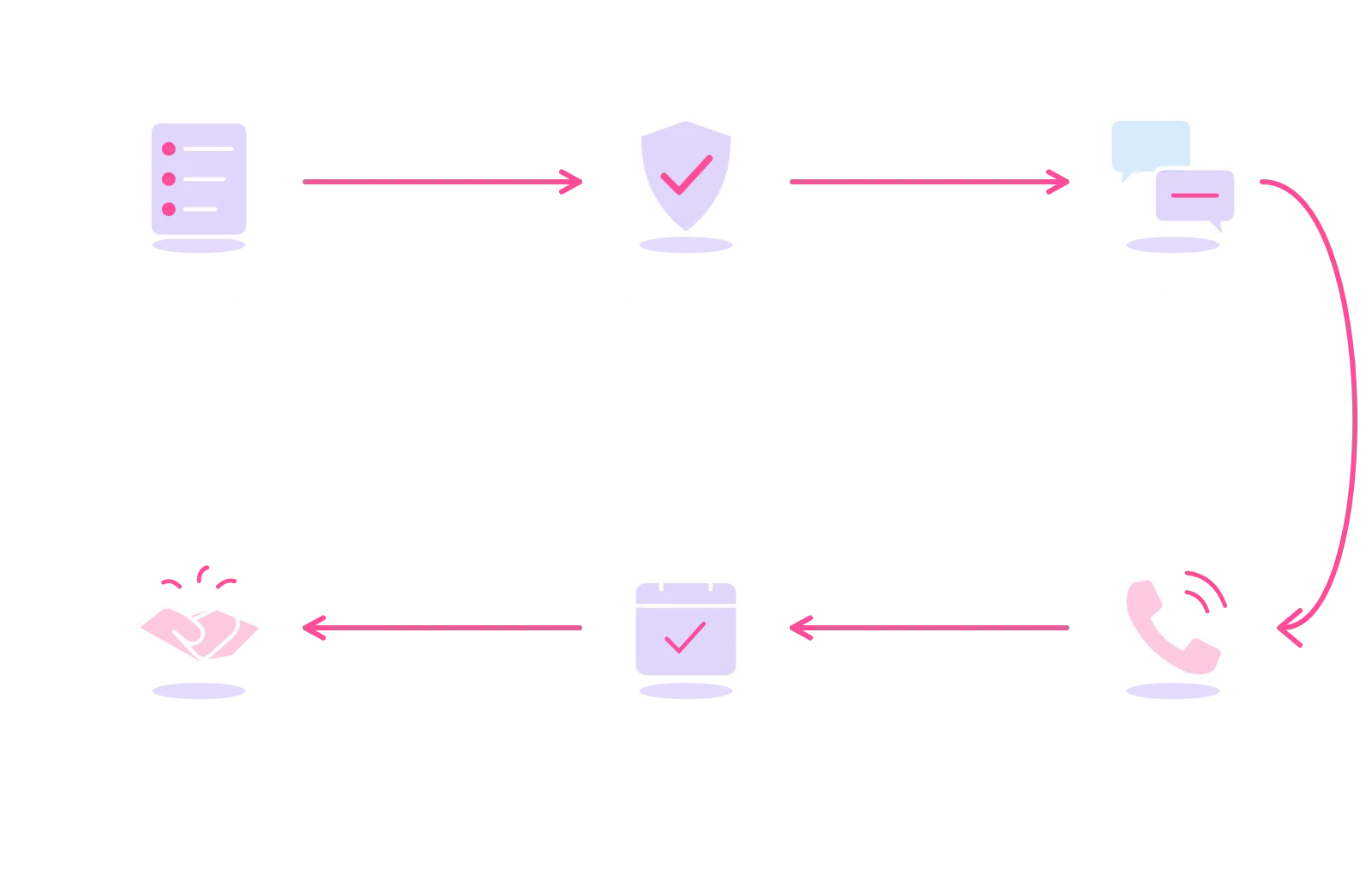
From lead list to booked meeting
- Agree the target: sector, company size, region and job title.
- Build and check the list: contacts that match, with details checked.
- Screen against the rules: numbers checked against the TPS and CTPS registers before any live call.
- Run the sequence: calls, emails and LinkedIn messages over several weeks.
- Qualify: is there a need, who decides, and is there a timescale.
- Book and brief: the meeting goes in the seller's calendar with a short note on who, why and what they said.
- Confirm and report: a reminder, a rebook if missed, and a report on what happened.
What counts as a qualified meeting
Most guides stop at "booked meeting". A meeting is only worth something if the right person turns up with a reason to talk. Write your definition down first:
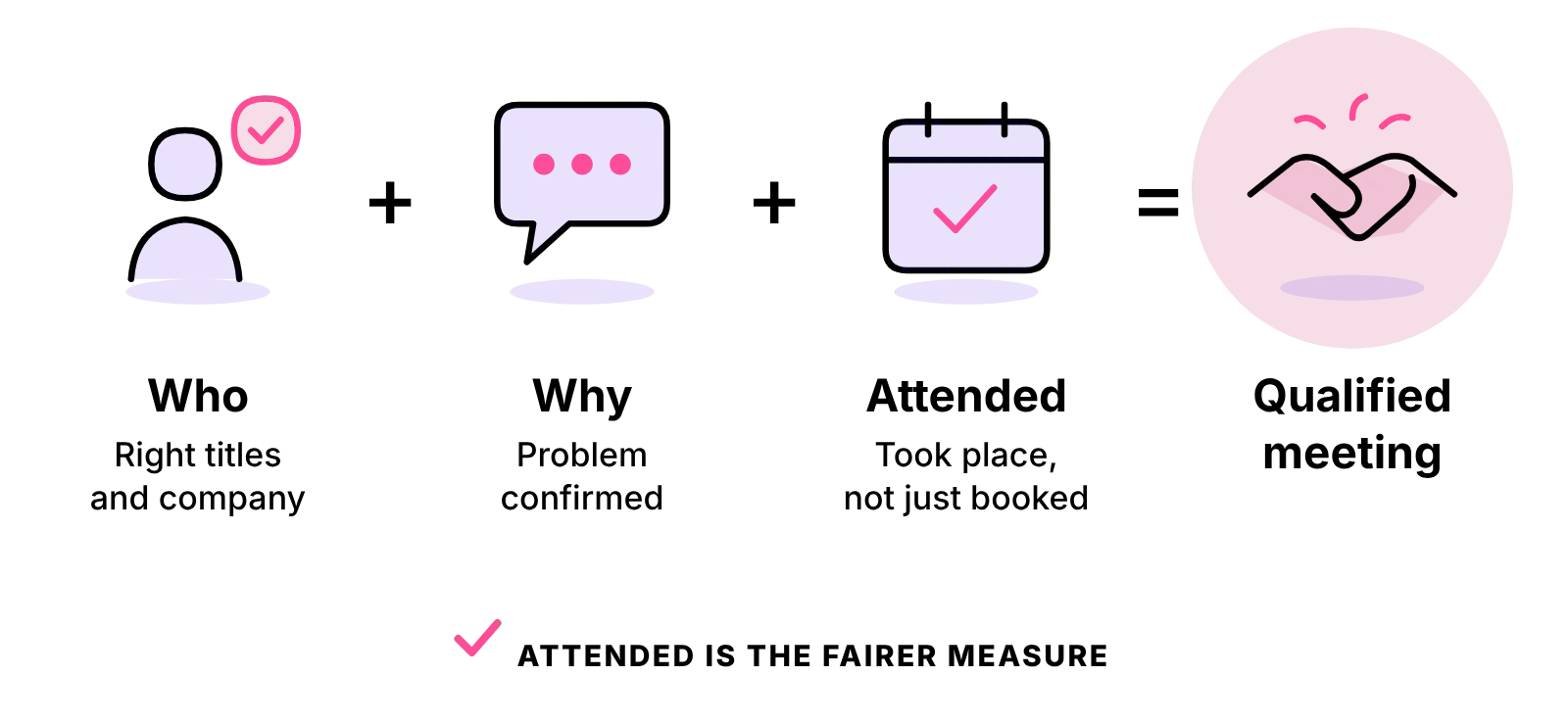
- Who: the job titles and company profile that count.
- Why: what the prospect must have confirmed, for example that they have the problem you solve.
- Attended: whether a meeting counts when booked or only when it takes place. Attended is the fairer measure, and the one to agree with any provider.
For qualifying frameworks, see our guide on how to qualify leads.
How it fits with lead generation and sales
Lead generation finds people who might buy, appointment setting turns them into conversations, and sales closes. In a small business the middle step is the one dropped when work is busy. In larger teams the job is often called a sales development representative, or SDR.
Email and phone outreach
Most B2B campaigns combine phone, email and LinkedIn. Two examples to adapt:
Example call opener (illustrative):
"Hello, is that [name]? It's [your name] from [company]. We help [type of business] with [problem]. I'm calling to see whether a short conversation with [colleague], our [job title], would be useful. Would [day] or [day] suit you better?"
Example email (illustrative):
Subject: [Specific topic] at [their company]
Hi [first name], [one sentence that shows you know something specific about their business]. We work with [type of business] on [problem], and [colleague] would like to show you how in a short call. Would [day] at [time] or [day] at [time] work? If the timing is wrong, tell me and I will stop chasing.
[Your name], [company], [phone number]
Keep the request small and offer two specific times. Our outsourced cold calling page covers phone campaigns run for you.
A worked example
This is an illustrative example, not a client case.
A UK IT support firm wants meetings with practice managers at accountancy firms in the Midlands. A qualified meeting means the prospect has confirmed they are unhappy with their current IT support and will take a call with the owner.
The setter builds the list, removes TPS and CTPS registered numbers, then calls, emails, connects on LinkedIn and calls again the next week. A practice manager answers the second call and says their provider is slow to respond. The setter checks who decides and when the current arrangement ends, books a call in the owner's calendar, and sends a brief: name, practice, the complaint and the decision-maker. A reminder goes the day before, the meeting takes place, and the setter logs it as attended.
Skills, tools and best practice
Skills
A confident phone manner, short natural emails, resilience, an ear for the real objection behind "send me some information", and tidy CRM records.
Tools
A CRM, a shared calendar, a phone system that logs calls and an outreach email account, all in your own name so the history stays with you.
Common mistakes
- Booking meetings outside the profile to hit a number
- Pitching the product instead of booking the meeting
- Stopping after the first attempt
- Sending the seller in with no brief
- Calling without TPS and CTPS screening
- Measuring calls made instead of qualified meetings attended
Is appointment setting legal in the UK?
Yes, appointment setting is legal in the UK. Calling or emailing businesses to book meetings is lawful when you follow the Privacy and Electronic Communications Regulations (PECR). The ICO's guidance on business-to-business marketing sets out the rules. This is general information, not legal advice.
PECR, TPS and CTPS
- Do not make live marketing calls to numbers registered with the Telephone Preference Service (TPS) or Corporate Telephone Preference Service (CTPS) unless they have told you they are happy to receive your calls. Screen your list against both registers before you call.
- Say who is calling and display your number.
- Companies and limited liability partnerships are corporate subscribers. Sole traders and some partnerships are treated as individuals, which changes the rules, especially for email.
A compliant call or email
The caller gives their name and company, the number shows, and it was screened first. As good practice, record and honour any request not to be contacted. Our guide on whether cold calling is legal in the UK covers the detail, and our FAQ on how lead data is kept secure covers data handling.
What appointment setters earn
There is no official UK salary figure for appointment setters. The closest official source is the National Careers Service job profile for sales representatives, a related role, which gives a typical starting salary of £23,000 and £50,000 when experienced, and notes that advertised pay may include on-target earnings. Treat these as context for a related job, not as an appointment setter's pay.
Basic pay versus on-target earnings
Sales roles are often advertised with a basic salary and on-target earnings (OTE): the basic plus the commission paid if the person hits target, usually qualified meetings for a setter. Compare basic with basic and OTE with OTE, and check what triggers the bonus.
In-house or outsourced
Why businesses use appointment setters
Time and consistency. Owners close best but rarely keep outreach going, because client work always wins. One person working the list daily builds a pipeline you can plan around.

Questions to ask a provider
- Is the setter dedicated to my business or shared?
- Who screens the list against TPS and CTPS?
- What counts as a qualified meeting, and do you report booked or attended?
- Whose CRM, phone system and email accounts are used?
- What happens if the setter is not the right fit?
Hiring in-house gives control, plus salary, employer National Insurance, pension and management costs. Our guide on how to hire a VA for lead generation walks through the choice.
Outsourcing appointment setting to a virtual assistant
At Ant Assist your appointment setter is one dedicated VA, never shared, UK-managed and working full time from our own managed office in Cairo, where they are recruited, managed and supervised. They are not freelancers and not AI, and they work UK business hours, 9am to 5pm Monday to Friday, from 20 hours a week up to a full 40-hour VA. If the fit is wrong, we replace the VA without restart cost. NDAs, data-processing agreements, password managers and revocable access protect your lead data. If you want outreach beyond booking, a lead generation virtual assistant can cover the wider work.
The introductory rate is £5 per hour for the first 6 months on the Entry tier (3 months on Mid, 1 month on Expert). After that, lead generation Entry is £5.50 per hour full time (£880 a month for 160 hours) or £6.50 per hour part time (£520 a month for 80 hours). Compare it with an in-house hire in the calculator, and see how a VA reports lead generation results.



Appointment setting FAQs
Didn't find your answer? Browse more common questions in the Help Center.
Meetings booked, so you can sell.
One dedicated appointment setter, from £5 per hour.
A free 15-minute call, no obligation. Or get an instant estimate with the calculator.