
Virtual receptionist for law firms in the UK
A virtual receptionist can answer a law firm's calls and book consultations, but the firm stays accountable under the SRA Codes, so choose a provider you can supervise.
Tools our VAs use for this


A virtual receptionist for a law firm answers calls in your firm's name, takes structured details from new enquiries, books consultations, puts existing clients through to the right fee earner or takes a message, and logs every call. It does not give legal advice or discuss a matter. The firm stays accountable for client confidentiality and data protection when calls are handled by someone it contracts with, so the decision rests on the provider's confidentiality arrangements, its processor contract and how its staff are supervised. For cover beyond the phone, a customer support VA is another option.
On this page
What a virtual receptionist does for a law firm
A virtual receptionist (some providers say "legal answering service") is a person who answers your firm's phone remotely, during the hours you set, from your instructions. For the general role, task by task, see our guide to what a virtual receptionist does. This section covers what is different on a law firm's line.
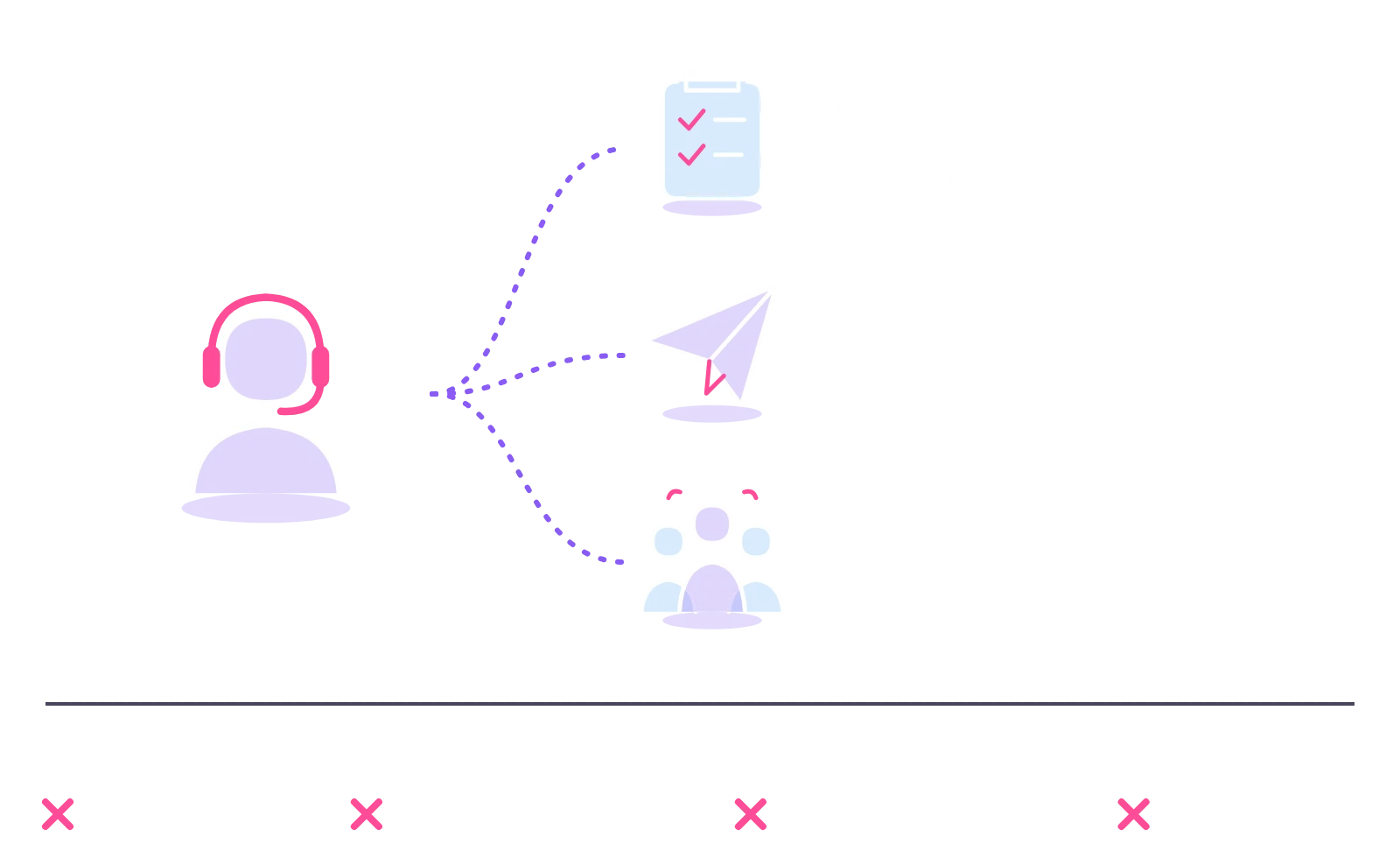
A virtual receptionist for law firms typically handles:
- New enquiries: the caller's name, contact details, the area of law, the other party's name for your conflict check, any deadline the caller mentions and how they heard of you. The receptionist books a consultation if your rules allow, or passes the enquiry to the right person the same day.
- Existing clients: puts the call through to the fee earner, or takes a message with the matter reference and the reason for the call when the fee earner is unavailable.
- Other callers: opposing solicitors, courts, experts and suppliers, each routed by the rules you set.
- Diary work: booking, moving and confirming consultations and calls in your own calendar.
- Call records: a short note of each call in your case management system, practice inbox or CRM.
How calls are answered and passed on
The call arrives on your number and is forwarded to the receptionist. They answer with your firm's greeting, identify the caller and the reason, and follow your call rules: put through, take a message, book or escalate. The message reaches the right person straight away, by email or your practice's chat tool, with what the caller needs and what they were told.
What the receptionist does not do
They do not give legal advice, comment on a matter, quote fees beyond what you publish, or confirm whether someone is a client to a caller who has not been verified. Your call rules should say exactly what may be said to whom.
Virtual versus in-house receptionist
An in-house receptionist greets visitors, handles post and documents and answers the phone. If clients visit your office often, that presence is part of the job. A virtual receptionist covers the phone and the diary without the desk, which suits a firm whose clients mostly ring and email, a firm with no front desk, or a firm that wants the phone covered while its in-house receptionist is at lunch, on holiday or dealing with a visitor. Our guide to virtual receptionist for small business covers the wider picture.

Many firms use both: the in-house receptionist for the office, and a virtual receptionist for overflow and absences.
Benefits and limits
New enquiries
A caller with a legal problem often rings several firms. A person who answers, takes the details and books a time gives your firm the first conversation. Voicemail gives it to whoever picks up next.
Cover during court, meetings and lunch
Fee earners can stay in a hearing or meeting without the phone pulling them out. Calls that genuinely cannot wait come through by the rules you set. Everything else arrives as a clear message.
Where it falls short
A virtual receptionist cannot receive documents in person, witness signatures or greet clients in reception. They know your firm only as well as your briefing allows, so a thin briefing produces thin answers. And their hours are whatever you agree: cover outside them needs to be arranged.
Confidentiality, SRA duties and UK GDPR
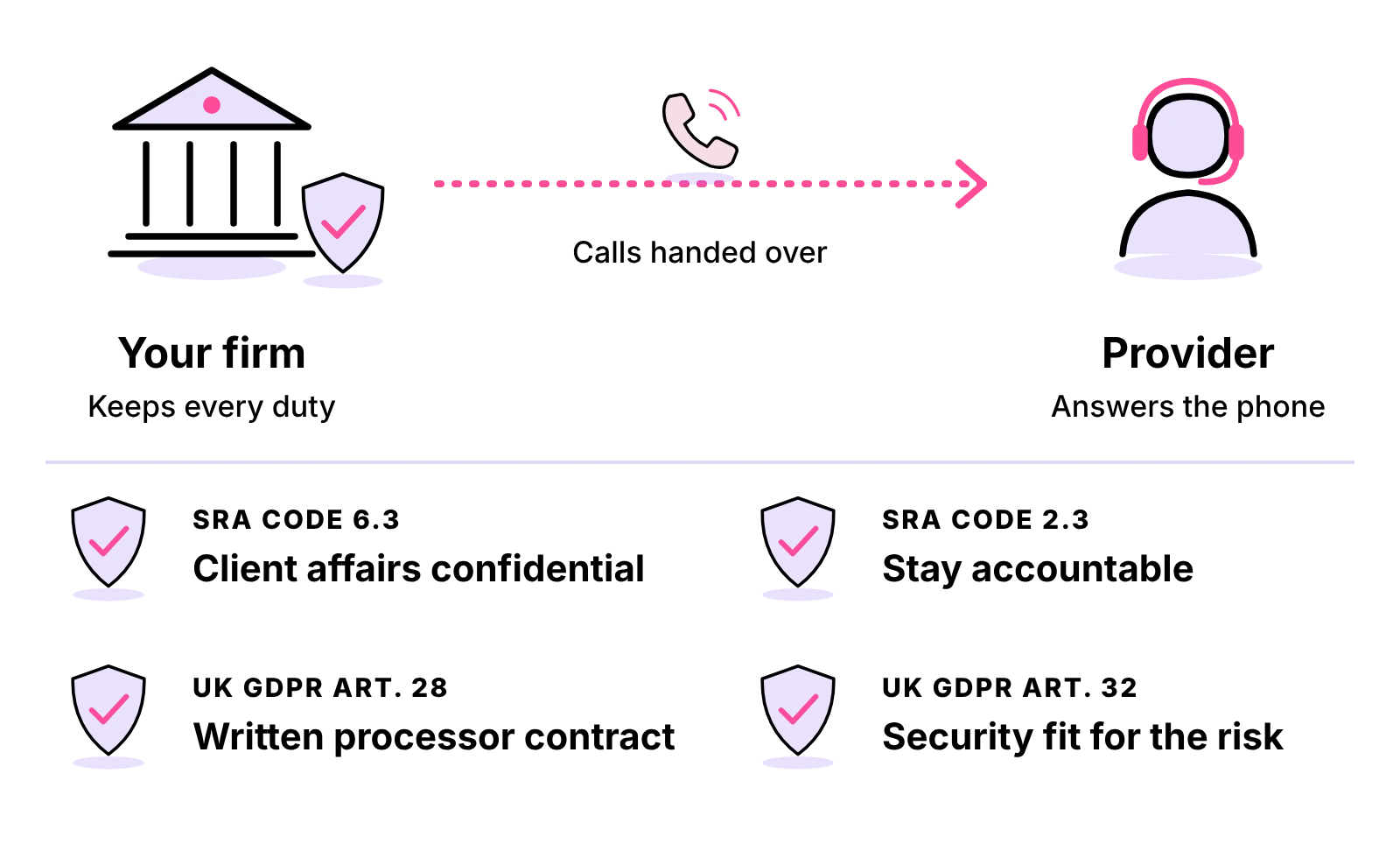
A law firm keeps its SRA confidentiality and UK GDPR duties when a virtual receptionist answers its phone, so it needs a written processor contract, confidentiality agreements and controlled access. The duties below sit with the firm, whoever answers the phone. This is general information, not legal advice.
Client confidentiality under the SRA Codes
The SRA Code of Conduct for Firms requires a firm to keep the affairs of current and former clients confidential unless disclosure is required or permitted by law or the client consents (paragraph 6.3; the Code for Solicitors carries the same wording). The SRA's guidance on confidentiality of client information says the duty exists under both common law and data protection legislation, and that client information should not be passed to third parties without the client's consent. Your call rules and the provider's confidentiality terms need to fit that.
Accountability when work is outsourced
Paragraph 2.3 of the same Code says a firm remains accountable for compliance with the SRA's regulatory arrangements where its work is carried out through others, including those it contracts with. Handing the phone to a provider does not hand over responsibility. Choose a provider you can supervise: one that follows your written rules, reports on calls and lets you check its work.
Processor contracts and security under UK GDPR
Callers give the receptionist personal data, so the provider processes it on your behalf. UK GDPR Article 28 says a controller must use only processors that provide sufficient guarantees of appropriate technical and organisational measures, and that the processing must be governed by a binding contract. Article 32 requires both controller and processor to put in place security appropriate to the risk. In practice: a written processor contract, named staff under confidentiality agreements, controlled access to your systems and a way to remove that access at once.
Confidentiality in practice
Ask a provider to show you, in writing, how it keeps your callers' information confidential. At a minimum, look for confidentiality agreements (NDAs) signed by every person who handles your calls, a data-processing agreement with your firm, access to your systems through a password manager so credentials are never shared in plain text, and the ability for you to revoke that access at any time. Keep what the receptionist sees to the minimum each call needs: a call directory and a diary, not your case files.
What a legal virtual receptionist costs
What a legal virtual receptionist costs depends on the pricing model and on the hours, call volume and work each call involves. Pooled answering services usually charge per call, per minute or by monthly bundle. A dedicated receptionist is usually charged by the hour, whatever the number of calls.
What drives the price
The hours covered, call volume, the length of calls, how much the receptionist does on each call (a message, a transfer, a consultation booked, a note in your case management system) and whether you need evening or weekend cover.
How to compare quotes
Put each quote on the same basis: a month of your real call volume, in your real hours. Add set-up fees, charges for transfers and for unwanted calls, and the cost of any minimum term. Our guide to virtual receptionist pricing UK sets out the models in more detail.
Call transfers, after-hours calls and messages
Transfers to the right fee earner
Give the receptionist a simple directory: who handles which area of law, who covers for whom, and when each person takes calls. Agree what happens when a transfer is not answered: a message, a booked call-back, or a second named person.
After-hours calls
Some practice areas get calls in the evening or at weekends, such as a client arrested overnight or a family emergency. Decide which of those your firm will respond to and how. Our guide to the after-hours answering service explains the options for evening, weekend and overnight cover.
Nuisance and sales calls
Tell the receptionist which callers you never take: cold sales, marketing surveys, recruiters. They should be handled politely and logged, and you should ask any provider whether it charges for them.
Lost messages
Ask the provider how messages are logged, whether you can search them, and how a missed or wrong message is reported and corrected. A firm that relies on messages needs a written trail: each message logged with the caller, the matter reference, the reason, what was promised and who it was sent to. For ticket-style follow-up, see our helpdesk virtual assistant guide.
How to choose a legal call answering provider
The general method for comparing answering services is in our guide to the best answering service for small business. For a law firm, add these.

Questions to ask on legal call handling
- Will the same person answer our calls every time?
- How do you train the receptionist on our practice areas and our call rules?
- What may the receptionist say to a caller who asks about a matter?
- How do you handle a caller who will not give their details?
- How do you record and deliver new-enquiry details for our conflict check?
Contract and data checklist
Copy this list and work through it before you sign.
- A written processor contract covering documented instructions, confidentiality and security
- Confidentiality agreements signed by every person who handles your calls
- Where staff work, and who supervises them
- How access to your diary, inbox and case management system is granted and removed
- Whether calls are recorded, who can hear recordings and how long they are kept
- How a lost or wrong message is reported to you
- The minimum term, the notice period and what happens to your data when the service ends
Team location
Ask where the people answering your calls work, who supervises them, and whether they work from a managed office or from home. For a firm with confidentiality duties, supervision is part of the answer.
AI or human receptionists for legal calls
Automated answering can greet callers and route them, but a law firm's callers are often anxious, unclear about what they need or ringing about something sensitive. Whether software or a person should take those calls is the subject of our guide to AI receptionist vs human receptionist.
Getting help from a dedicated virtual receptionist
Ant Assist provides one dedicated receptionist for your firm, never shared with another client. Your receptionist is a person, not AI and not a freelancer: recruited, managed and supervised full time in Ant Assist's own managed office in Cairo, under a UK-managed service. Standard cover is UK business hours, 9am to 5pm Monday to Friday, with extended hours and weekend cover available at additional cost. This is one form of a dedicated customer service assistant.
Every VA signs NDAs and data-processing agreements. Access to your systems is through password managers, and you can revoke it at any time. You can start at 20 hours a week and go up to a full 40-hour VA, and if the fit is wrong we replace the VA without restart cost.
The introductory rate is £5 per hour for the first 6 months on the Entry tier (3 months on Mid, 1 month on Expert). After that, customer service Entry is £5.95 per hour full time (£952 a month for 160 hours) or £6.50 per hour part time (£520 a month for 80 hours). Put your own hours into the calculator to compare.



Questions from law firms
Didn't find your answer? Browse more common questions in the Help Center.
Every enquiry answered in your firm's name.
A dedicated receptionist under NDA, from £5 per hour. Book a free call.