
AI receptionist or human receptionist?
An AI receptionist wins on frequent, simple calls; a human wins when the calls are the business. A common mix is a person by day and AI after hours.
Tools our VAs use for this


Choose an AI receptionist for frequent, simple calls and a human one when the calls are the business.
| Choice | Best for |
|---|---|
| AI receptionist | Messages, opening times, bookings into a slot and transfers, at any hour |
| Human receptionist | Enquiries to qualify, anxious or angry callers and complaints |
| Both | AI for the overflow and the small hours, a human for the calls that matter |
An AI receptionist answers instantly, round the clock, at a cost per call no human can match, and it never has a bad day. A human is the better choice wherever the caller's decision to stay with you is made in the first minute. A dedicated human receptionist from Ant Assist starts at £5 per hour on the entry rate.
This guide covers what an AI receptionist does well, described as mechanism rather than marketing; where it falls short and what a human does instead; what each really costs, including the costs that are not on the price list; and which suits which business, ending with a plain recommendation by situation. It does not name or price AI vendors, because their products and prices change monthly and you should read them from their own pages; it does state our own price, because that one we control.
On this page
What an AI receptionist does well
An AI receptionist answers instantly at any hour, handles simple repeated calls reliably, scales without hiring, stays consistent and is cheap per call. It answers instantly, every time, at any hour. No queue, no voicemail, no lunch break. For a business that loses calls out of hours or during peaks, that alone can be worth having.
It handles the simple, repeated call reliably. Opening hours, directions, "is my order ready", "can I book Tuesday at ten", "please tell them I called". Where the caller's need is one of a known list, a well-configured AI receptionist resolves it and logs it.
It scales without hiring. A hundred calls in an hour cost the same per call as ten. For a seasonal business or a campaign launch, that removes the staffing problem entirely.
It is consistent. The script is followed exactly, the message is captured in full, the booking goes into the right slot. Nothing is forgotten because it was a busy afternoon.
It is cheap per call. However the vendor prices it, the cost of an AI-answered call is a fraction of a human-answered one. For high volumes of simple calls that difference is decisive.
Where AI answering falls short and a human steps in
AI answering falls short on calls it was not configured for, callers who need a person, and judgement inside your rules, which is where a human receptionist steps in. The call that is not on the list. AI is configured for the calls you expected. The caller who has two problems, or the wrong problem, or a problem you have never had before, gets the nearest scripted answer or a transfer. A human receptionist asks a question, works out what is going on and handles it, or escalates it with the context written up.
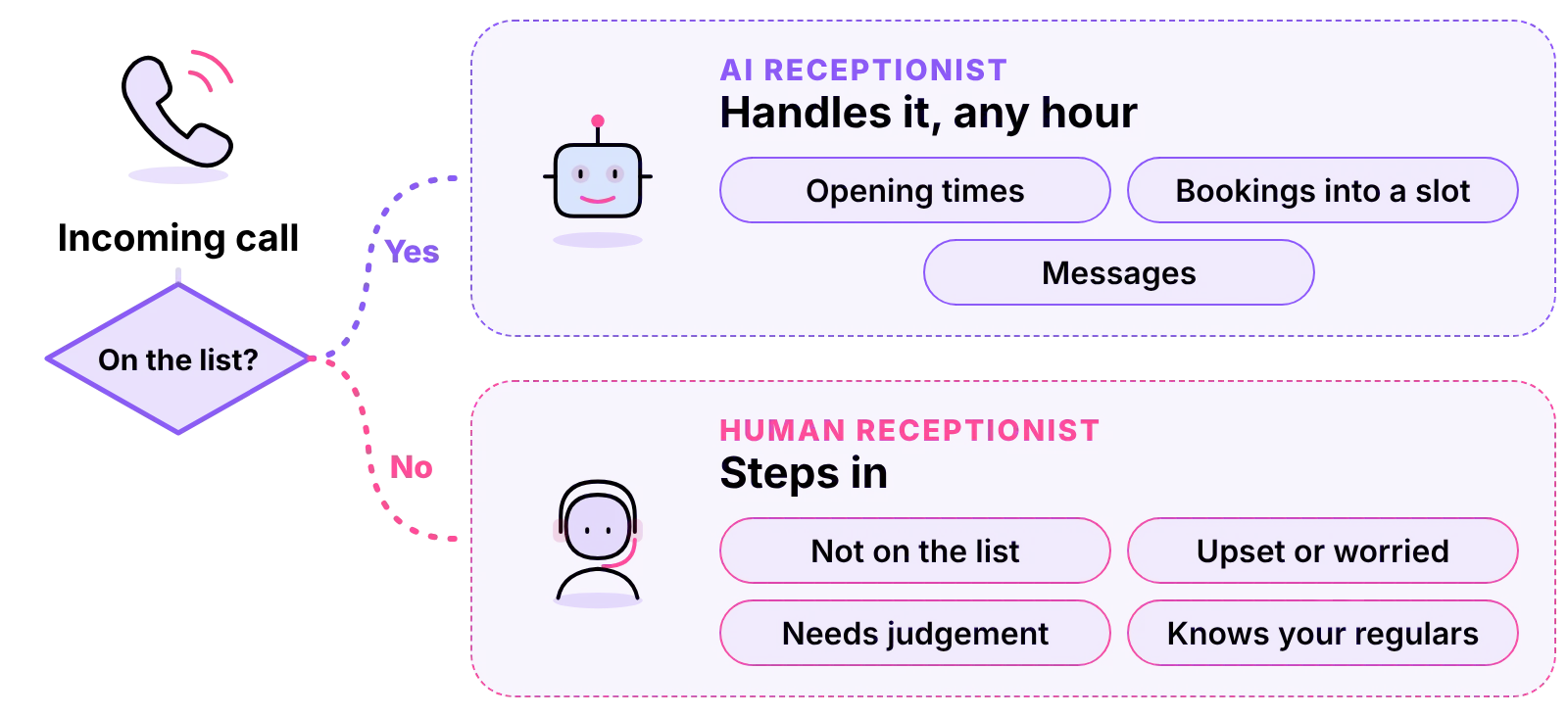
The caller who needs a person. Some calls are emotional before they are practical: the complaint, the worried patient, the client whose deadline has moved, the customer who has been passed around already. The moment they realise they are talking to software, the call changes. A human receptionist trained on your tone and your scenarios is what those callers came for. If you choose the human option, outsourced customer service is one way to staff the phone.
Judgement inside your rules. A diary with lead times, buffers and priorities; a client who is never kept waiting; a supplier who always is. AI applies rules; a dedicated human learns them and applies them with judgement, and notices when a rule should be broken and asks you.
Recognition and continuity. A dedicated receptionist knows your regulars, remembers what was promised last week and reads the CRM before answering. AI can look up a record; it does not know your business.
The brand risk. Every caller who hangs up on a bot is a caller you did not hear from. You will not see that in any report, because the AI logs the call as handled.
The channels between calls. A human receptionist covers your live chat and your shared inbox when the phone is quiet, screens callers with the questions you set, books and moves appointments in your own diary and updates the CRM after every call. The virtual receptionist UK page lists the six tasks; an AI receptionist does the first of them.
AI and human receptionist costs compared
Per call, an AI receptionist is cheapest by a distance, but per business outcome the cheaper option depends entirely on what your calls are. AI receptionist. A subscription or a per-call or per-minute charge, plus setup, plus the time someone in your business spends writing and maintaining the scripts, plus the human who still has to handle the transfers, the exceptions and the messages the AI captured. The price list shows the first item; the others are yours.

Human answering service. Per call, per minute or a monthly bundle with overage, with a rotating pool of agents reading your script. Cheap at low volume, expensive at high volume, and never the same person twice. Our guide to virtual receptionist pricing UK sets out the models.
In-house receptionist. A UK salary plus employer National Insurance, pension, holiday, a desk and the recruitment when they leave. Right when presence in the building is the job.
Dedicated human receptionist, by the hour. One named person on your phone, your chat, your inbox and your diary, for an hourly rate, whatever the call volume does. At Ant Assist that is £5 per hour on the entry rate for the first 6 months on the Entry tier, 3 months on Mid, 1 month on Expert; after the promotion the customer service rate card applies, £5.95 per hour full time on the Entry tier (160 hours a month, £952) or £6.50 per hour part time (80 hours a month, £520), with Mid at £6.84 and Expert at £7.44 per hour full time. There are no per-call or per-minute charges; the rate includes the receptionist's time, our office facilities in Cairo, and the supervision and management that keep quality up. Put your own hours into the calculator for the comparison against an in-house hire.
The honest summary: per call, AI is cheapest by a distance. Per business outcome, it depends entirely on what your calls are.
Which businesses suit each option
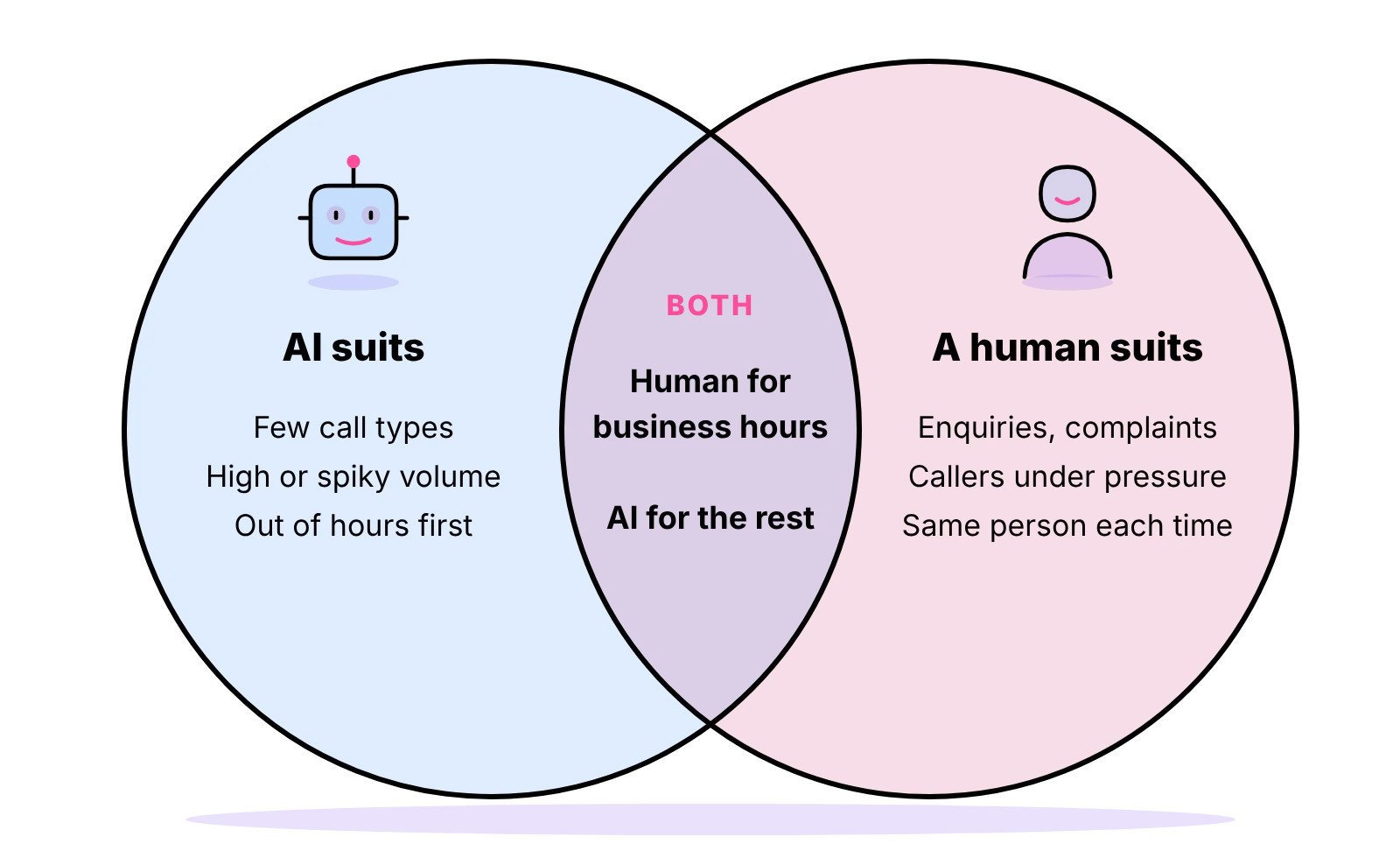
AI suits you if your calls are mostly one of a short list; volume is high or spiky; out-of-hours answering matters more than in-hours quality; your callers are transactional and expect automation; and you have someone to own the scripts and the exceptions.
A human suits you if your calls are enquiries, bookings with rules, complaints or anything that decides whether the caller stays; your callers are people under some pressure: patients, clients, customers with a problem; the same person every time is part of what you sell; and you want the phone, the chat and the inbox covered by one person who knows the business.
Both suit you if you have steady daytime calls that need a person and a long tail of simple calls outside hours. A dedicated human receptionist for your business hours and an AI receptionist for the rest is a common and sensible arrangement, and the human should own the AI's scripts and review its logs. For a smaller firm weighing this up, our guide to a virtual receptionist for small business is a good place to start.
We sell the human option, and we will tell you on the first call if your calls sound like a job for software.
Pricing a dedicated receptionist VA
A dedicated receptionist from Ant Assist starts at £5 per hour on the entry rate: the first 6 months on the Entry tier, 3 months on Mid, 1 month on Expert. After the promotion, the customer service rate card applies: £5.95 per hour full time on the Entry tier (160 hours a month, £952) or £6.50 per hour part time (80 hours a month, £520), with Mid at £6.84 and Expert at £7.44 per hour full time for receptionists with longer experience. There are no platform fees, and no per-call or per-minute charges. Hours and tier set the price; extended hours and weekend cover are available at additional cost, agreed during onboarding.
What the £5/hour entry rate includes
- Dedicated VA, never shared
- UK-hour aligned support
- Management and supervision included
- Recruitment and onboarding included
- Office infrastructure included
- VA replacement available
- No NI, pension, or holiday costs
- 3-month probation, no penalty to leave
A receptionist VA as the human option
A dedicated human receptionist fits the business whose phone is where customers decide: clinics and practices, trades and field businesses that miss calls on site, professional services that need a human first answer, and stores adding phone and chat to their e-commerce customer service outsourcing. Law firms are one example; see our guide to virtual receptionist for law firms. Our guide to what a virtual receptionist does describes the role task by task. At Ant Assist the receptionist is a real, office-based person, not an AI product, trained on your tone, scenarios and escalation rules before taking a call, with a UK team supervising quality, and if the fit is wrong we replace the VA and carry the handover.



Questions about AI call answering
Didn't find your answer? Browse more common questions in the Help Center.
A person answers. Every time.
One dedicated human receptionist, from £5 per hour. Book a free 15-minute call.