
Helpdesk virtual assistant: how ticket handling works
A helpdesk virtual assistant owns the queue: routine tickets answered from your macros, the rest escalated with context, and repeat questions turned into help articles so the queue shrinks.
Tools our VAs use for this


A helpdesk virtual assistant owns your support queue: they triage every new ticket, answer routine ones from your macros and policies within the response time you set, escalate the rest to you with context, chase open tickets to closure and turn repeat questions into help articles.
On this page
The ticket lifecycle, stage by stage
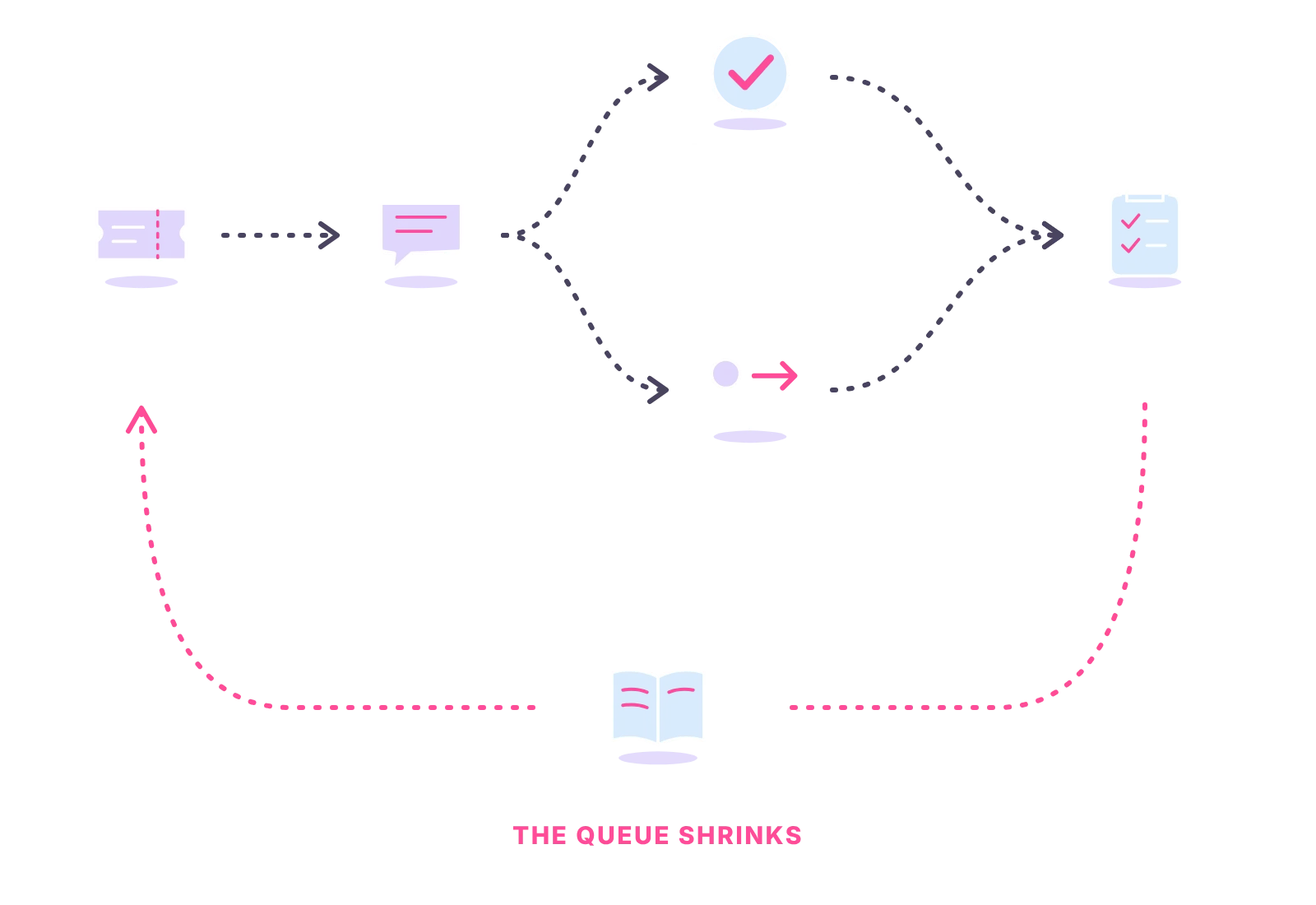
The help desk ticket lifecycle has six stages: triage, first response inside the standard, resolution from macros and policy, escalation with context, follow-up and closure, and knowledge base maintenance.
Triage
Every new ticket read, tagged, prioritised and routed within minutes of arriving: urgent to you, routine to the VA, misdirected to the right inbox. A dedicated helpdesk VA runs this stage and every one after it.
First response inside the standard
An acknowledgement or an answer within the first-response time you set, so the customer knows a person has it.
Resolution from macros and policy
Order status, returns, delivery, how-to, account questions: answered from your canned responses and your rules, personalised to the ticket, closed with a confirmation.
Escalation with context
Anything outside the VA's authority goes to you or a named colleague with the ticket history, what the customer wants and what the VA recommends, so the decision takes a minute.
Follow-up and closure
Tickets waiting on the customer chased, tickets waiting on you chased, and nothing left open past the age you allow.
Knowledge base maintenance
The questions that arrive three times a week become help articles and macro updates, so the queue shrinks over time instead of growing.
Helpdesk tools a VA works in
Our VAs work across email (Gmail, Outlook), helpdesks (Zendesk, Freshdesk, Help Scout, Intercom), live chat tools (Tidio, LiveChat, Drift), and telephone via VoIP platforms. The helpdesk matters less than the setup inside it: views for the triage states, tags for the scenarios, macros for the routine answers and an SLA policy the tool can measure. A VA can build that setup during onboarding if it does not exist. If you are still answering support from a shared inbox, a free tier of one of these tools is usually the first improvement, because it gives the queue a state: new, open, waiting on customer, waiting on you, closed. Without states, nothing can be measured and nothing can be handed over.
Setting up the queue so a VA can own it
To set up a queue a VA can own, write the scenarios, define the service standard, draw the escalation line, give access through a password manager and agree the daily line. Write the scenarios before the person starts. The twenty ticket types that make up most of the queue, each with the answer, the policy behind it and the point at which it comes to you.
Define the service standard. First-response time and resolution time by priority, in hours, written into the helpdesk's SLA policy so it is measured rather than remembered.
Draw the escalation line in one sentence. What the VA never decides alone: refunds outside policy, complaints from named accounts, anything legal, anything that mentions safety.
Give access through a password manager. The helpdesk, the store, the order system: the VA works inside your accounts, never a copy, and you can revoke access at any time.
Agree the daily line. Tickets opened, closed, escalated, oldest open ticket, and anything waiting on you, in one message at the end of each day.
The first 30 days on the help desk
Week one: the VA reads the last month of tickets, learns the tone from your best replies, and drafts answers you approve before they go. The output is the scenario document, corrected against real tickets.
Week two: routine tickets go out after a quick review; escalations start arriving with context; the daily line starts and you read it.
Weeks three and four: routine tickets are answered and closed unreviewed; the first help articles go up; the SLA report shows where the queue stands. You keep one weekly review slot for the numbers and the escalations.
A UK team supervises quality throughout. If the fit is wrong, we replace the VA and carry the handover.

Five metrics for a healthy ticket queue
The five metrics for a healthy ticket queue are first-response time by priority, resolution time and first-contact closure, escalations per week, the oldest open ticket and tickets per help article. First-response time by priority, against the standard you set. Customers judge speed before they judge the answer.
Resolution time and the share of tickets closed on first contact. A rising first-contact rate means the scenarios are documented well and the macros are right.
Escalations per week, and how many were necessary. Too many means the scope is too narrow or the policies are missing; too few means the VA is deciding things they should not.
Oldest open ticket. One number that exposes everything the other four hide.
Tickets per help article. When an article goes up, the tickets on that question should fall; if they do not, the article is not findable or not answering the real question.
Your VA reports these in the daily line and a weekly summary; the helpdesk's own reports confirm them. Read the weekly summary for the first month, then monthly.
Which teams a help desk VA suits
A help desk VA suits small businesses supporting customers from a shared inbox, online and subscription businesses with recurring tickets, support teams needing a second pair of hands, and agencies or SaaS firms with service standards. Small businesses whose support runs from a shared inbox. The queue is invisible, replies depend on who saw the email first, and the founder is the backstop. A VA plus a helpdesk gives the queue an owner and a state. Smaller teams can also look at a virtual receptionist for small business.
Online stores and subscription businesses with recurring ticket types. Order status, returns, billing and how-to questions are documentable, so they can be answered from macros by someone who is not you.
Support teams that need a second pair of hands without a second salary. One VA takes triage, first response and the routine tier, so the in-house person handles the cases that need judgement.
Agencies and SaaS businesses with a service standard to hit. When response times are in the contract, the queue needs someone on it every hour of the working day. Firms that answer clients by phone can read about a virtual receptionist for law firms.
What a help desk VA costs in the UK
A dedicated support VA from Ant Assist starts at £5 per hour on the entry rate: the first 6 months on the Entry tier, 3 months on Mid, 1 month on Expert. After the promotion the customer service rate card applies: £5.95 per hour full time on the Entry tier (160 hours a month, £952) or £6.50 per hour part time (80 hours a month, £520), with Mid at £6.84 and Expert at £7.44 per hour full time. Extended hours and weekend cover are available at additional cost. The rate includes the assistant's time, our office facilities in Cairo, supervision and management; there are no platform fees on top. The comparison against a UK employee, line by line, is in how much a virtual assistant costs in the UK, and the calculator gives your figures for your hours.

For online stores, where the queue is mostly orders, returns and marketplace messages, e-commerce customer service outsourcing is the store-specific service; for phone-first businesses the virtual receptionist UK page covers calls. What that role covers day to day is set out in what a virtual receptionist does.
What the £5/hour entry rate includes
- Dedicated VA, never shared
- UK-hour aligned support
- Management and supervision included
- Recruitment and onboarding included
- Office infrastructure included
- VA replacement available
- No NI, pension, or holiday costs
- 3-month probation, no penalty to leave



Questions about outsourced ticket handling
Didn't find your answer? Browse more common questions in the Help Center.
Give the queue an owner.
One dedicated help desk VA, from £5 per hour. Book a free 15-minute call.