
How to write a customer service SLA
Set customer service SLA targets per channel from your own measured times, promise a little less than you usually achieve, and stop the clock outside opening hours.
Tools our VAs use for this


A customer service SLA states, for each channel and priority, how quickly a customer will get a first reply and how quickly the issue will be resolved, during which hours, and what happens if the target is missed. Set targets from your own measured times, promise a little less than you usually achieve, and stop the clock outside your opening hours. Whether you answer customers yourself or use a provider, a clear customer service SLA makes the standard visible to everyone.
On this page
What an SLA is in customer service
Service level agreements defined
An SLA, or service level agreement, sets the standard of service a customer can expect. It can be a promise to your customers, often published as "we reply to emails within one working day", or a commitment from a provider to you, written into your contract. In both cases it defines the service, the standard and the hours. The same standard applies if a customer support VA answers for you.
SLA, SLO and KPI compared
The SLA is the promise. An SLO (service level objective) is the specific target inside it, such as first reply within four business hours. A KPI is any number you track to run the team, including ones you never promise anyone. Keep internal targets a little tighter than the promise, so a bad day does not become a breach. Our guide to customer support KPIs covers what to measure.

Who needs one, including small businesses
Any business that answers customers benefits from a written standard, even if only the team sees it. You need a formal one when you hand support to a provider, or when business customers expect response times in their contract.
What a customer service SLA includes
- Channels covered: email, phone, live chat, social messages. Targets can differ by channel.
- Hours of cover: the days and times the clock runs, and how bank holidays are handled.
- Priority levels: for example urgent, normal and low, with a plain definition of each.
- Targets: first response time and resolution time for each channel and priority.
- Escalation: who takes over when a target is at risk, and how they are told.
- Measurement and reporting: what is measured, over what period, and who reports it.
- What counts as a breach, and what happens next.
- Exclusions: what the SLA does not cover, such as delays waiting for the customer or a supplier.
Word SLA template: hours, priorities, example targets, escalation, reporting, breaches and exclusions (.docx, Word, 38 KB)
SLAs are sometimes described by type: customer-based (one customer, all services), service-based (one service, all customers) or multi-level (a general standard plus extra tiers). A small business usually needs only one service-based SLA.
Response time and resolution time
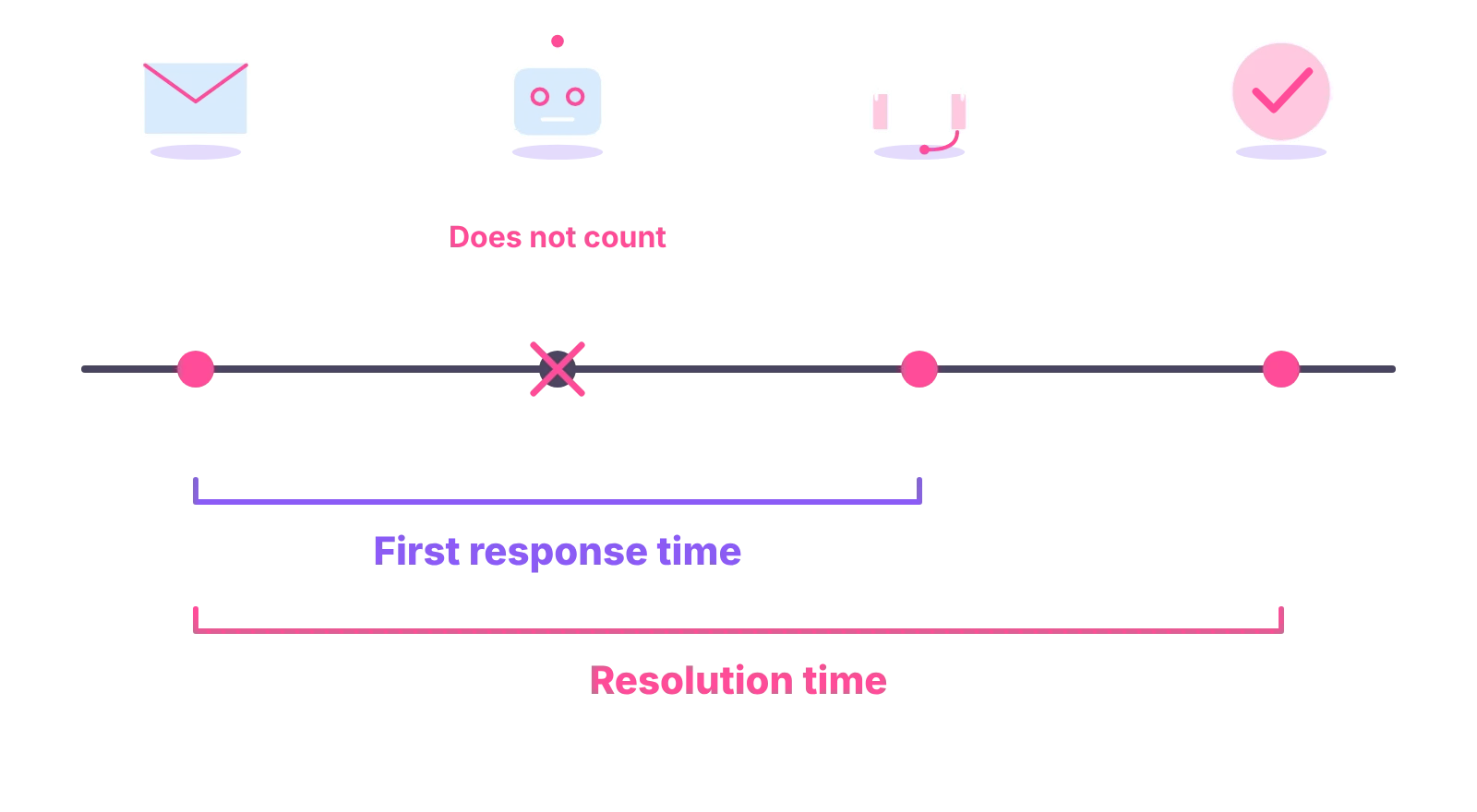
First response time is the time from a customer's message to the first reply from a person; an automatic acknowledgement does not count. Resolution time is the time until the issue is solved and the customer has not had to come back. Measure both in business hours if the SLA promises business hours. Report them as the share of conversations that met the target over a week or a month, for example the share of emails answered within the promised time.
Targets by channel and priority
As an example, a small business might answer live chat within 2 minutes, urgent emails within 2 business hours and normal emails within 1 business day; no official source sets a UK norm. Set yours from a few weeks of your own measured times.
A sample target table
The figures below are an example for a small business open 9am to 5pm Monday to Friday. They are not an industry standard; change them to match what you can reliably deliver.
| Channel | Priority | First response (example) | Resolution (example) |
|---|---|---|---|
| Phone | All | Answered while open, or a call-back the same business day | Most on the call; the rest within 2 business days |
| Live chat | All | Within 2 minutes while chat is shown as online | During the chat, or moved to email |
| Email and web form | Urgent (order failed, wrong item, payment problem) | Within 2 business hours | Within 1 business day |
| Email and web form | Normal | Within 1 business day | Within 3 business days |
| Social messages | Normal | Within 1 business day | Moved to email or phone if it needs personal details |
Targets within UK business hours
If you answer customers 9am to 5pm Monday to Friday, say so next to every promise: "We reply to emails within one working day, Monday to Friday." The clock stops at 5pm and starts at 9am the next working day, so an email sent on Friday evening is due on Monday. Set your auto-reply and chat widget to show the hours, and hide chat when nobody is there to answer. If you need evenings or weekends, our guide to the after-hours answering service explains the options.
How to write, roll out and review an SLA
Write it in plain words, check it against a month of real conversations, then publish or sign. Common drafting mistakes:
- Promising the same time on every channel when phone and email work differently.
- Leaving "resolved" and "business day" undefined.
- No exclusions, so you breach while waiting for the customer.
- Targets taken from another business instead of your own data.
Report against the SLA weekly and review it every few months, or when hours, staff or volume change. Speed is only half the standard: our guide to customer service quality assurance covers checking that fast answers are also right.
Breaches, service credits and legal status
An SLA is legally binding when it is a term of its contract, and a breach can bring a service credit, a review meeting or, if repeated, a right to end the contract. This is general information, not legal advice.

Penalties and service credits
A provider SLA often says what happens on a breach: a service credit (a reduction in the fee), a review meeting, or a right to end the contract after repeated breaches. A customer-facing promise usually comes with an apology and a fix rather than money.
Is an SLA legally binding in the UK?
An SLA is binding when it is a term of the contract it sits in, and what happens on a breach depends on that contract, so read your own. Separately, the law adds a baseline. Under section 13 of the Supply of Goods and Services Act 1982, where a supplier acts in the course of a business, there is an implied term that the service will be carried out with reasonable care and skill. For consumers, section 49 of the Consumer Rights Act 2015 sets the same standard.
What an SLA cannot guarantee
An SLA sets a standard; it cannot make every customer happy or every issue quick. It also cannot excuse a careless answer delivered on time, which is why speed targets sit alongside a quality check.
SLAs for an outsourced or VA team
When someone else answers your customers, put the SLA in writing before they start. Ask the provider to commit to the hours of cover, the first response and resolution targets by channel, the escalation route to you, and a weekly report of performance against each target. Agree how targets are measured and what happens when they are missed. Our guide on how to hire a VA for customer support covers the hiring steps. For the cost side, see outsourcing customer service cost in the UK.
Working to an SLA with a virtual assistant
An Ant Assist customer service VA works UK business hours, 9am to 5pm Monday to Friday, which is the clock your SLA runs on as standard; extended hours and weekend cover are available at additional cost. Your VA is one dedicated person, never shared, recruited, managed and supervised in Ant Assist's own office in Cairo, with UK management. Agree your targets and reporting during onboarding. If the fit is wrong, the VA is replaced without restart cost. Cover starts from £5 per hour on the introductory rate; the calculator shows the monthly cost for your hours.


SLA FAQs
Didn't find your answer? Browse more common questions in the Help Center.
Promises your customers can rely on.
A dedicated customer service VA, from £5 per hour. Book a free 15-minute call.