
How to hire a VA for customer support: the UK guide
Support is judged on tone under pressure and accuracy at speed, so test a customer support VA on a real, awkward ticket rather than in an interview.
Tools our VAs use for this


Hiring a VA for customer support takes five steps:
- Brief: sort last month's tickets by who could answer them.
- Test tone and policy discipline on a real, awkward ticket.
- Ask which queues they have run, and in which tools.
- Price it: Ant Assist starts at £5 per hour.
- Write down your tone, policies and escalation rules before day one.
For the short version, which covers live chat as well, see How to hire a VA for customer support and live chat.
On this page
Tickets, chat and calls a support VA takes over
A customer support VA takes over the front line, everything a customer sends you on every channel: email and tickets, live chat, inbound calls, refunds and complaints, the help desk and post-purchase follow-up. It is the same job whether you hire in-house or choose customer support outsourcing. Six tasks account for most of it.
Email & ticket response
Replies to customer emails within your SLA, escalates anything outside their scope to you and keeps the ticket queue moving instead of ageing.
Live chat coverage
Staffs your live chat during your business hours, or extended hours where you need them, turning website visitors into qualified conversations. Ready-made wording is in live chat scripts for website support.
Inbound call handling
Answers calls under your brand, takes messages, schedules callbacks and routes urgent issues to you immediately.
Refunds, returns & complaints
Processes refunds and exchanges to your standards, defuses complaints and escalates only when a decision is yours to make.
Help desk & knowledge base
Maintains your help articles and updates the FAQs from real ticket patterns, so self-service improves and the queue shrinks over time.
Post-purchase follow-up
Reaches out after delivery to confirm satisfaction, request reviews and surface problems before they become public ones.
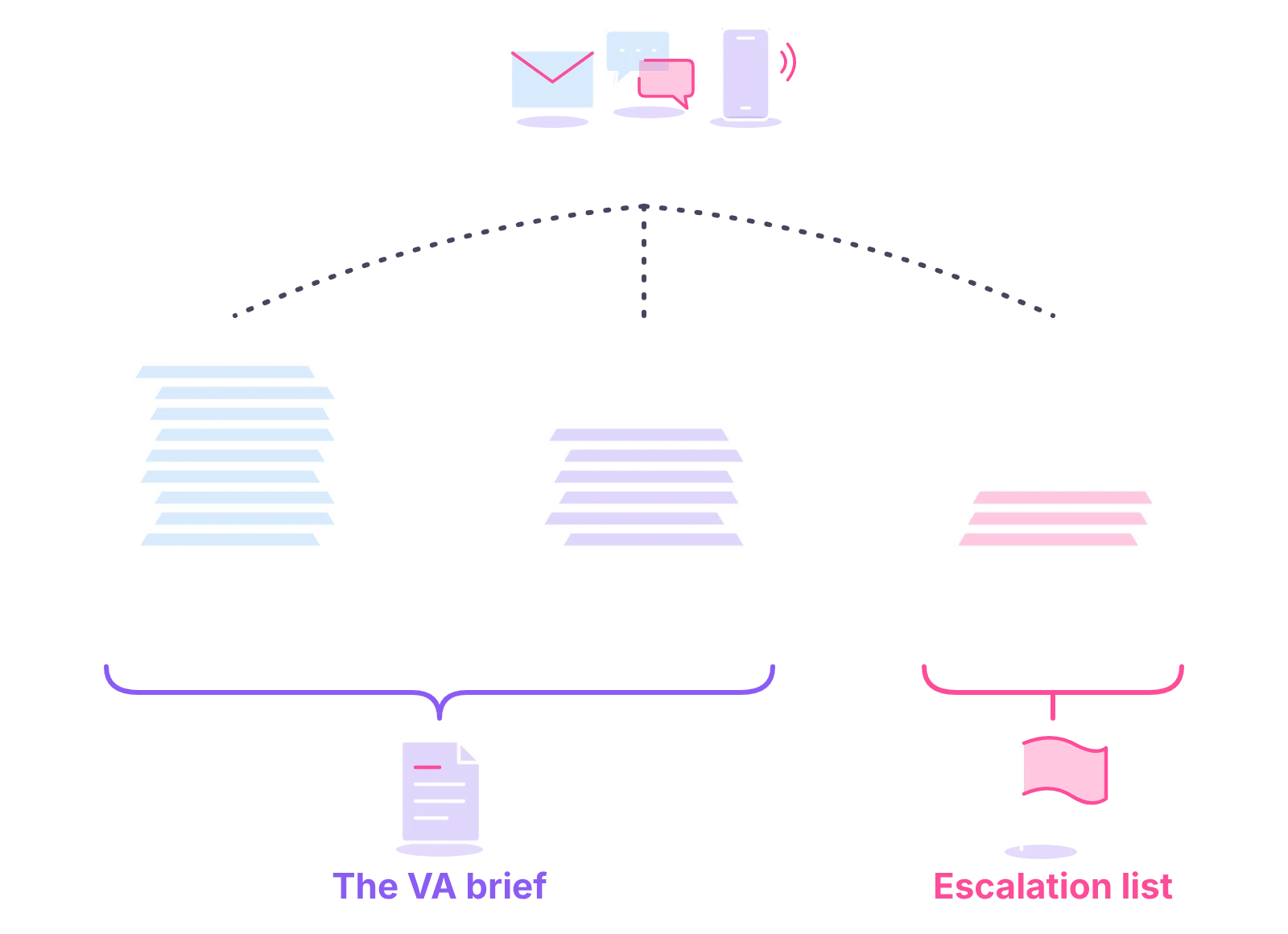
Before you hire, pull last month's tickets and sort them into three piles: answered from a template, answered with a judgement call, and answered only by you. The first two piles are the brief. The third pile is your escalation list, and it should be short. For the general steps, see how to hire a virtual assistant.
Skills and tools to look for in a customer support VA
Support is judged on tone under pressure and on speed that does not sacrifice accuracy. Test for both.
Tone you would put your name to. Give a candidate a real, awkward ticket: a late delivery, a refund outside policy, an angry one-line email. Read the reply as the customer. It should sound like your brand, not like a call centre, and it should resolve or clearly escalate, never stall.
Policy discipline. A support VA works inside rules: what can be refunded, what needs a photo, when to offer a replacement. Ask how they handle a customer who pushes past the policy. The right answer is calm, consistent and ends with an escalation rule, not a concession.
Channel fluency. Email in Gmail or Outlook; a helpdesk such as Zendesk, Freshdesk, Help Scout or Intercom; chat tools such as Tidio, LiveChat or Drift; calls over a VoIP platform. A candidate does not need all of them, but should have owned a queue in at least one helpdesk and be able to describe how tags, macros and SLAs were used.
Writing things down. Good support assistants turn repeated tickets into help articles and macros without being asked. Ask what they built last time that reduced the number of tickets they had to answer.
Escalation instinct. The candidate should be able to say, in one sentence, what they would never decide alone. If they cannot, they will either bother you with everything or decide things they should not.
Questions to ask a customer support VA candidate
Ask a customer support VA candidate which tasks they have owned and in which tools, how they report their work, what happens when something is outside their scope, and how they handle access and customer data. Four questions, asked of a freelancer, an agency candidate or a managed provider, expose the difference between someone who has run a queue and someone who has answered a few emails.
Which of these tasks have you owned before, and in which tools?
Ask for the business, the channel, the tool and the volume: how many tickets a day, what the SLA was, what the rating was. Then ask what went wrong. A support person with no story about a complaint that got away from them has not been on the front line.
How do you report what you did each day or week?
You want numbers you can read in a minute: tickets closed, first-response time, anything escalated and why, the patterns they noticed. A good answer names a format and a time; a vague one means you will be reading the helpdesk yourself to find out what happened. The numbers worth asking for are set out in customer support KPIs for small teams.
What happens when something is outside your scope?
The right answer is a procedure, not a promise: flag it to you or a named colleague immediately, with the context already written up, and do not act until told. Support meets the edge of scope many times a day, and a clean handover at that edge is the whole job.
How do you handle access, passwords and customer data?
Support VAs see names, addresses, order histories and sometimes payment details. Listen for a password manager, for no discomfort with an NDA and a data-processing agreement, and for an understanding that customer data stays in your systems and never leaves them.
If you are hiring through a managed provider, ask the provider the same four questions about the assistant they propose, with the assistant's name attached.
What a customer support VA costs
A customer support VA's price depends on the hiring model more than the task, from a UK salary with employment costs to a managed VA's hourly rate. A UK-based support hire, employed or through a UK agency, costs what a UK salary costs plus employer National Insurance, pension, holiday, a desk and your management time, and covering more than one channel usually means more than one person. A freelancer's hourly rate looks lower until you add the hours you spend recruiting, briefing and covering gaps in the rota.
A managed support VA from Ant Assist starts at £5 per hour on the entry rate: the first 6 months on the Entry tier, 3 months on Mid, 1 month on Expert. After the promotion, the customer service rate card applies: £5.95 per hour full time on the Entry tier (160 hours a month, £952) or £6.50 per hour part time (80 hours a month, £520), with Mid at £6.84 and Expert at £7.44 per hour full time for assistants with longer experience. Extended hours and weekend cover are available at additional cost. There are no platform fees on top, and the rate includes the assistant's time, our office facilities in Cairo, and the supervision and management that keep quality up. For the comparison against a UK employee, line by line, read how much a virtual assistant costs in the UK or put your own hours into the calculator.

What the £5/hour entry rate includes
- Dedicated VA, never shared
- UK-hour aligned support
- Management and supervision included
- Recruitment and onboarding included
- Office infrastructure included
- VA replacement available
- No NI, pension, or holiday costs
- 3-month probation, no penalty to leave
A 30-day onboarding plan for a support VA
The first four weeks decide whether customers notice a change for the better.
Before day one. Document your tone of voice with real examples of replies you were proud of, your policies on refunds, returns and replacements, and your escalation rules: what gets flagged, to whom, and how fast. Set up helpdesk and chat access through a password manager, never by sharing credentials in a message.
Week one: shadow and draft. Your VA reads the last month of tickets, learns the tone and the recurring cases, and drafts replies you approve before they go. The output of the week is a shared document of your common scenarios and the answers to them.
Week two: the queue under review. Replies go out after a quick review; chat is covered during your hours; calls are answered under your brand with messages taken and callbacks booked. The daily summary starts and you read it.
Weeks three and four: ownership. Routine tickets are answered and closed without review. Refunds inside policy are processed. The help articles start to change based on what customers actually ask. You keep one weekly review slot to look at the numbers and the escalations, because that slot is what keeps the standard.
At Ant Assist a UK team supervises quality alongside you throughout, reviews the work with your VA, and adjusts hours and scope as your volumes change. If the fit is wrong, we replace the VA and carry the handover, with no re-recruitment and no restart from zero. Once the plan is agreed, a customer support VA can run the queue day to day.



Questions about hiring for customer support
Didn't find your answer? Browse more common questions in the Help Center.
Cover every ticket, from £5 an hour.
One dedicated support VA, trained on your tone. Book a free 15-minute call.