
How to hire an e-commerce virtual assistant, step by step
Write a store brief, choose a model that fits your peaks, test candidates on real store tasks, grant access task by task and run the first week on approval.
Tools our VAs use for this


Hire an e-commerce virtual assistant in five steps:
- Write a store brief: channels, daily volumes, tasks and hours.
- Choose the model that matches your peaks.
- Test candidates on three real store tasks.
- Grant access by task, through staff accounts and a password manager.
- Run the first week on approval, then widen ownership.
A managed, dedicated VA scales with the season and comes with supervision and replacement built in. Ant Assist provides a dedicated e-commerce VA from £5 per hour on the entry rate.
There are five steps, and they are in this order because each one produces what the next one needs. The brief tells you the hours and the platform experience to hire for. The model tells you who does the recruiting, supervising and replacing. The tests tell you whether a candidate can do the work in your admin, not in general. Access sets the boundaries the work runs inside. The first week turns the brief into the way the store actually runs. What follows is each step in detail.
For what the role covers, the skills to look for and what it costs, see how to hire a VA for e-commerce.
On this page
Step one: write the store brief
The store brief is one page covering your channels and platforms, daily volumes, the tasks in hand-over order, your hours across the year and the lines you will not cross. Before you speak to anyone, write one page.
Channels and platforms. Shopify, Amazon Seller Central, eBay, Etsy, WooCommerce, Wix, or a mix. The mix matters more than the volume: a VA who has run one channel can learn another, but a store on three marketplaces needs someone comfortable switching between them all day.
Daily volumes. Orders a day, messages a day, returns a week, listings to add a month. Round numbers are fine; the point is to know whether this is a part-time role or a full-time one.
The tasks, in the order you will hand them over. Customer messages and reviews, order processing, returns and exchanges, listing upkeep, inventory monitoring, new listings, marketplace housekeeping, supplier coordination. Our guide to the e-commerce tasks to delegate gives the order and the reasons.
Hours across the year. Your quiet months, your peak, and the weeks before the peak when the stock build and the listings need the most attention. A brief that says "part time from March, full time from October" hires better than one that says "flexible".
The lines you will not cross. Pricing, ad spend, supplier terms, marketplace policy actions. Write them down now so nobody has to guess later.
Step two: choose the hiring model
An in-house hire gives you someone in the building at the cost of a UK salary, employer National Insurance, pension, holiday, a desk and a fixed headcount that is too small in November or too large in February. A freelancer suits a defined project such as a catalogue build; for a daily role their absences are yours to cover and their knowledge of your store leaves when they do. An agency retainer gives you a ticket queue and a rotating team who learn your products every time. For hiring in general, see our guide to hiring a virtual assistant, step by step.

A managed, dedicated VA is one named person who learns your store once and stays, on your hours, for an hourly rate you scale up for the peak and back down afterwards, with the recruiting, supervising and replacing done by the provider. If you hire through a managed provider, ask them the same questions you would ask a candidate, and expect the answers to come with the assistant's name attached.
Step three: test on real store tasks
Test an e-commerce VA on real store tasks, because an interview only tells you whether someone talks well about e-commerce. Three short tasks in a sandbox or on a staging copy tell you whether they can do it.
A listing fix. Give a product with a wrong attribute, a missing image and a typo in the title, and ask for it corrected to your brand guidelines. You are testing accuracy and attention, not creativity.
A difficult message. A customer whose parcel arrived damaged, angry, on Amazon. Ask for the reply. You are testing tone, policy discipline and whether the candidate knows that marketplace messages have rules.
A returns scenario. An item returned outside the window with a plausible reason. Ask what they would do and what they would ask you. The right answer stops at the edge of the policy and hands over cleanly.
Ask the candidate, or the provider, which of your platforms the assistant has owned before, what they report each day and how they handle access. A candidate with no story about something going wrong in a store has not run one.
Step four: set access, permissions and the first live week
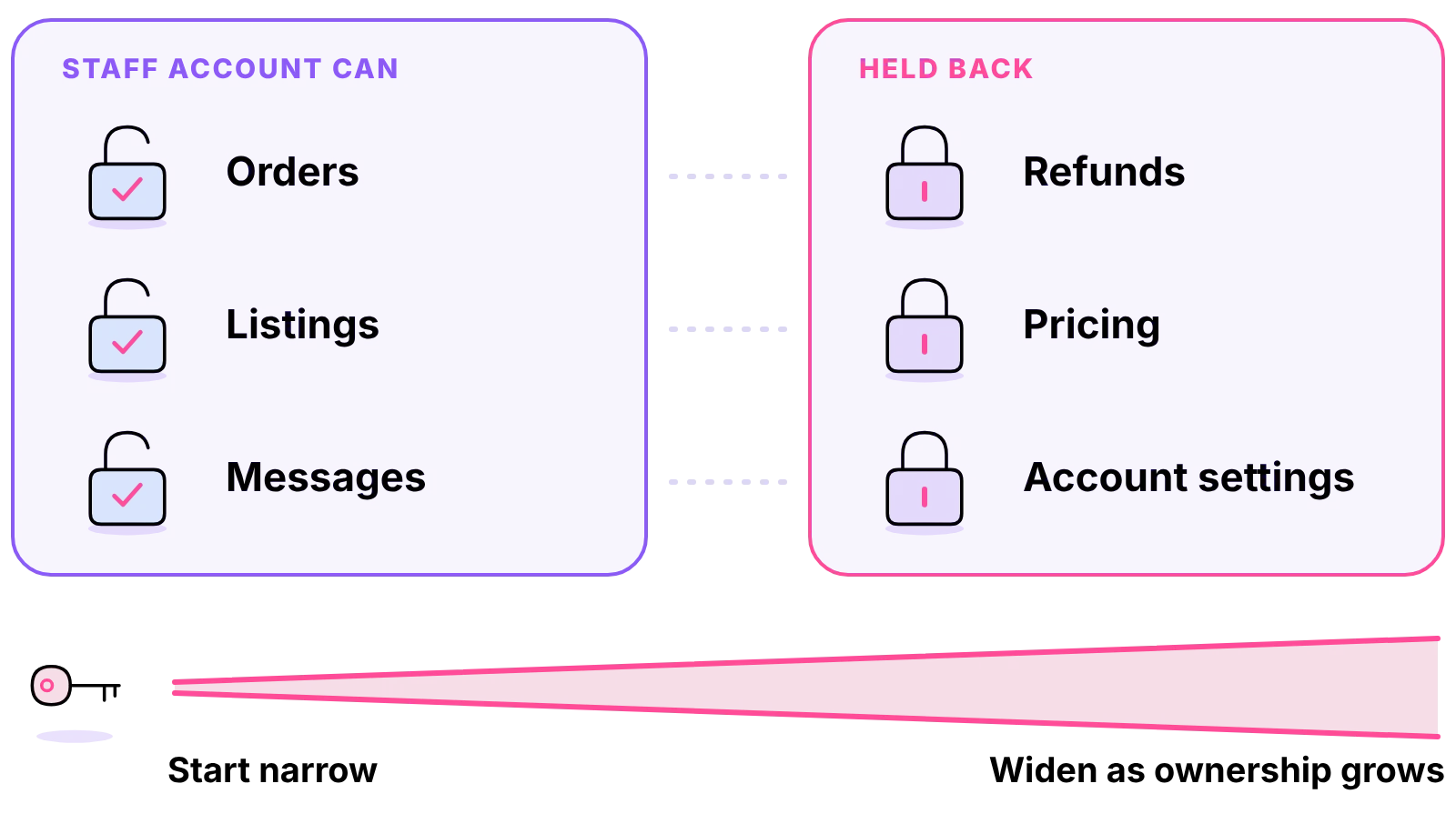
Grant access by task, not by handing over your login. Every major platform supports staff accounts with permissions: orders without refunds, listings without pricing, messages without account settings. Start narrow and widen as ownership grows. Credentials go through a password manager, never through a message, and the assistant works under an NDA and a data-processing agreement. Every Ant Assist VA signs both, works through password managers, and you can revoke access at any time.
The first week decides whether the store runs without you.
Day one. Walk the admin together: the daily rhythm, where each task lives, the policies, the escalation rules. Your VA processes nothing yet; they watch you process.
Days two and three. Listing upkeep and message drafts, every one approved by you before it goes live. The output is the shared document of how your store actually runs.
Days four and five. Orders and routine messages under review, with you checking a sample. The daily line starts: orders processed, messages answered, returns handled, stock flags, anything waiting on you.
By the end of the second week, routine messages, in-policy returns and order processing run without review; by the end of the month, stock monitoring and marketplace housekeeping join them, and you keep one weekly review of the numbers. At Ant Assist a UK team supervises quality alongside you throughout, and scales hours ahead of your seasons.
Hiring costs for an e-commerce VA
A managed e-commerce VA from Ant Assist starts at £5 per hour on the entry rate: the first 6 months on the Entry tier, 3 months on Mid, 1 month on Expert. After the promotion, the e-commerce rate card applies: £6.50 per hour full time on the Entry tier (160 hours a month, £1,040) or £6.80 per hour part time (80 hours a month, £544), with Mid at £7.48 and Expert at £8.13 per hour full time for assistants with longer experience. Hours can be scaled up for peak periods and back down afterwards without penalty. There are no platform fees on top, and the rate includes the assistant's time, our office facilities in Cairo, and the supervision and management that keep quality up.

The brief sets the price: hours and tier, driven by channels and volume. A single-channel store with routine orders and messages fits a part-time Entry VA; several marketplaces, a large catalogue or Amazon account health work moves the role to full time and often to the Mid tier. For the comparison against a UK employee, line by line, read how much a virtual assistant costs in the UK or put your own hours into the calculator. Set the figure against the cost of not hiring an e-commerce VA.
What the £5/hour entry rate includes
- Dedicated VA, never shared
- UK-hour aligned support
- Management and supervision included
- Recruitment and onboarding included
- Office infrastructure included
- VA replacement available
- No NI, pension, or holiday costs
- 3-month probation, no penalty to leave
Getting a dedicated e-commerce VA
A dedicated e-commerce VA fits any store where the daily work has outgrown the owner and the peaks make a fixed hire the wrong shape. The role is described on the e-commerce virtual assistant page; the platform versions are on the Amazon virtual assistant UK page and its Shopify and eBay counterparts, and catalogue work as a role in its own right is on the product listing virtual assistant page. If the fit is wrong, we replace the VA and carry the handover, with no re-recruitment and no restart from zero.



Questions about hiring for a store
Didn't find your answer? Browse more common questions in the Help Center.
Hire your store's VA.
One dedicated e-commerce VA, from £5 per hour. Book a free 15-minute call.