
E-commerce tasks to delegate to a virtual assistant
Delegate the repeatable e-commerce tasks first, starting with customer messages and orders. Keep anything with your money, your products or your key relationships in it.
Tools our VAs use for this


Delegate, in this order: customer messages and reviews, order processing and shipping updates, returns and exchanges, listing upkeep, inventory monitoring, new listings and catalogue expansion, marketplace housekeeping, supplier and courier coordination, promotions and discount setup, and the daily reporting that ties it together. Keep pricing, supplier contracts, the advertising budget and the product decisions.
Hand each task over with a policy, access at the level the task needs, one worked example and a check-in you read, and it stays delegated. A dedicated VA from Ant Assist does this from £5 per hour on the entry rate.
On this page
Which store tasks can be delegated
A store task is delegable when it repeats, when it has a finished state someone else can recognise, and when it does not need your authority or your money to complete. Nearly everything that happens inside the store admin passes: orders, messages, returns, listings, stock. What fails is the short list where a wrong answer costs real money or your account: pricing, ad spend, supplier terms, and anything Amazon or eBay would hold you accountable for that has not yet been turned into a rule your VA can follow.
The test also predicts where delegation goes wrong. A task handed over without a policy comes back as questions; a task without a finished state comes back half done; a task that secretly needed your money comes back as an argument with a customer. The order below puts the tasks with the clearest policies first.
Ten e-commerce tasks to delegate, first to last
- Customer messages and reviews. First, because the store is judged on response time and the work is rule-based once your voice and your policies are written down. Your VA responds to reviews and marketplace messages on Amazon, eBay and your store, protecting your seller rating, and brings anything sensitive to you as a draft.
- Order processing and shipping updates. Processing orders, tracking fulfilment, handling cancellations and address changes, updating shipping statuses and coordinating with couriers. Daily, high volume, and the task whose backlog customers notice first.
- Returns and exchanges. Return authorisations, exchanges and refunds within your policy, and the pattern-spotting that reduces return rates. Hand this over with the policy and the goodwill limit written down; the rest is process.
- Listing upkeep. The image swaps, attribute fixes, typo corrections and variant updates that never reach the top of your list. Low risk, and the fastest way for a new VA to learn the catalogue.
- Inventory monitoring. Stock checks across SKUs and channels on a schedule, reorder flags before bestsellers go out of stock, slow movers reported. Your VA counts; you keep the buying decision until the thresholds have proved themselves.
- New listings and catalogue expansion. Creating product pages and marketplace listings from your product information and brand guidelines. The product listing virtual assistant page describes this as a role in its own right.
- Marketplace housekeeping. Account health checks, cases and performance notifications, feedback requests, buy box and suppressed-listing checks, done to the marketplace's policies. On Amazon this needs someone who works inside the rules; the Amazon virtual assistant UK page covers what that means.
- Supplier and courier coordination. Liaising with manufacturers, freight forwarders, 3PLs and couriers to keep the supply chain moving: chasing dates, checking deliveries against orders, logging discrepancies. The rule at the edge: anything that changes a price or a contract comes to you.
- Promotions and discount setup. Building the discount codes, the sale collections and the marketplace deals you have decided on, on the dates you set. Your VA executes; the offer itself is yours.
- Daily reporting. The line at the end of each day: orders processed, messages answered, returns handled, stock flags raised, anything waiting on you. Last because it depends on the rest, and the first thing you will miss if it stops.
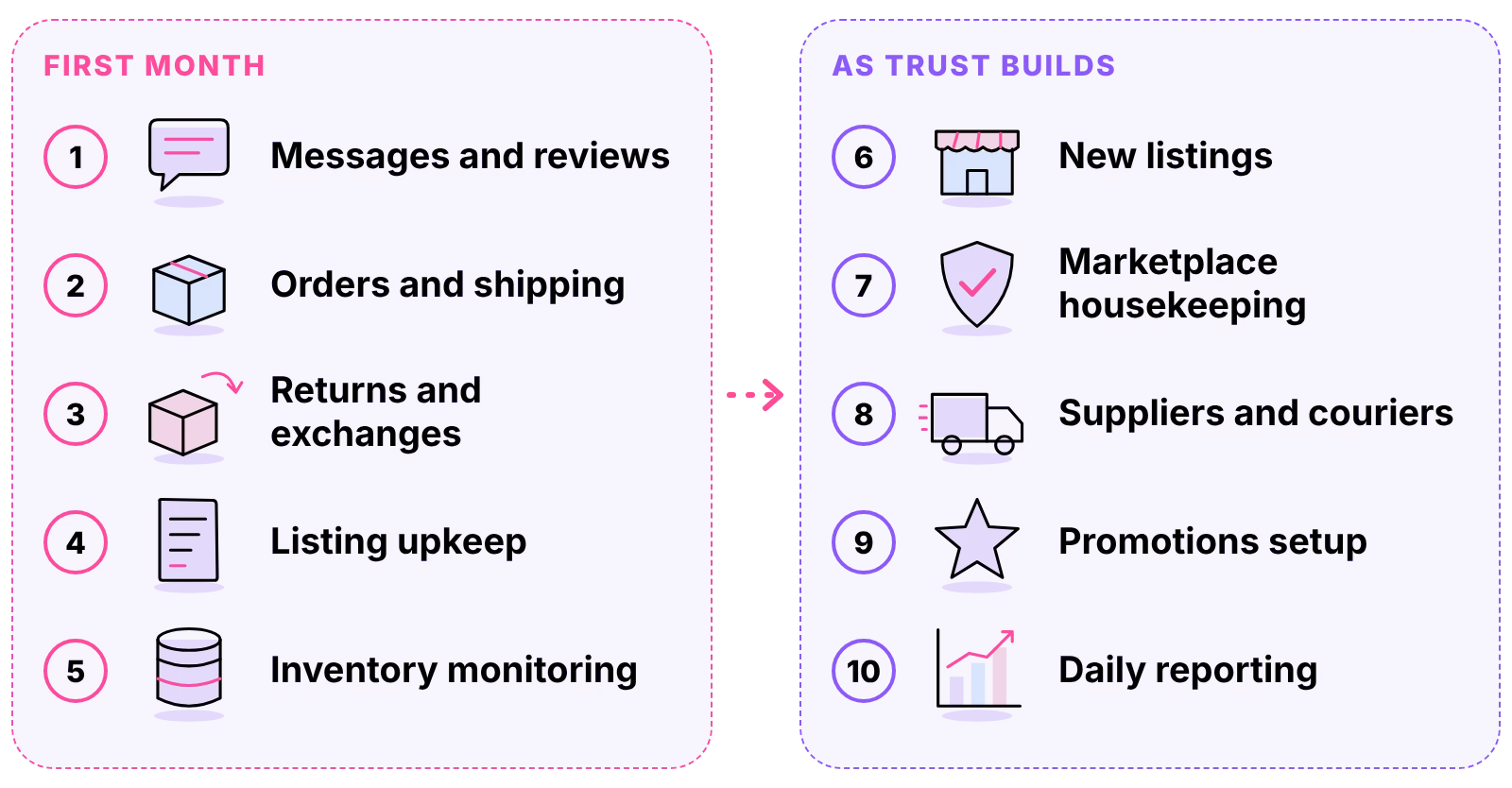
Most stores hand over the first five within the first month and the rest as trust builds. The e-commerce virtual assistant service page describes the role that carries all ten for one store.
Store work the owner should keep
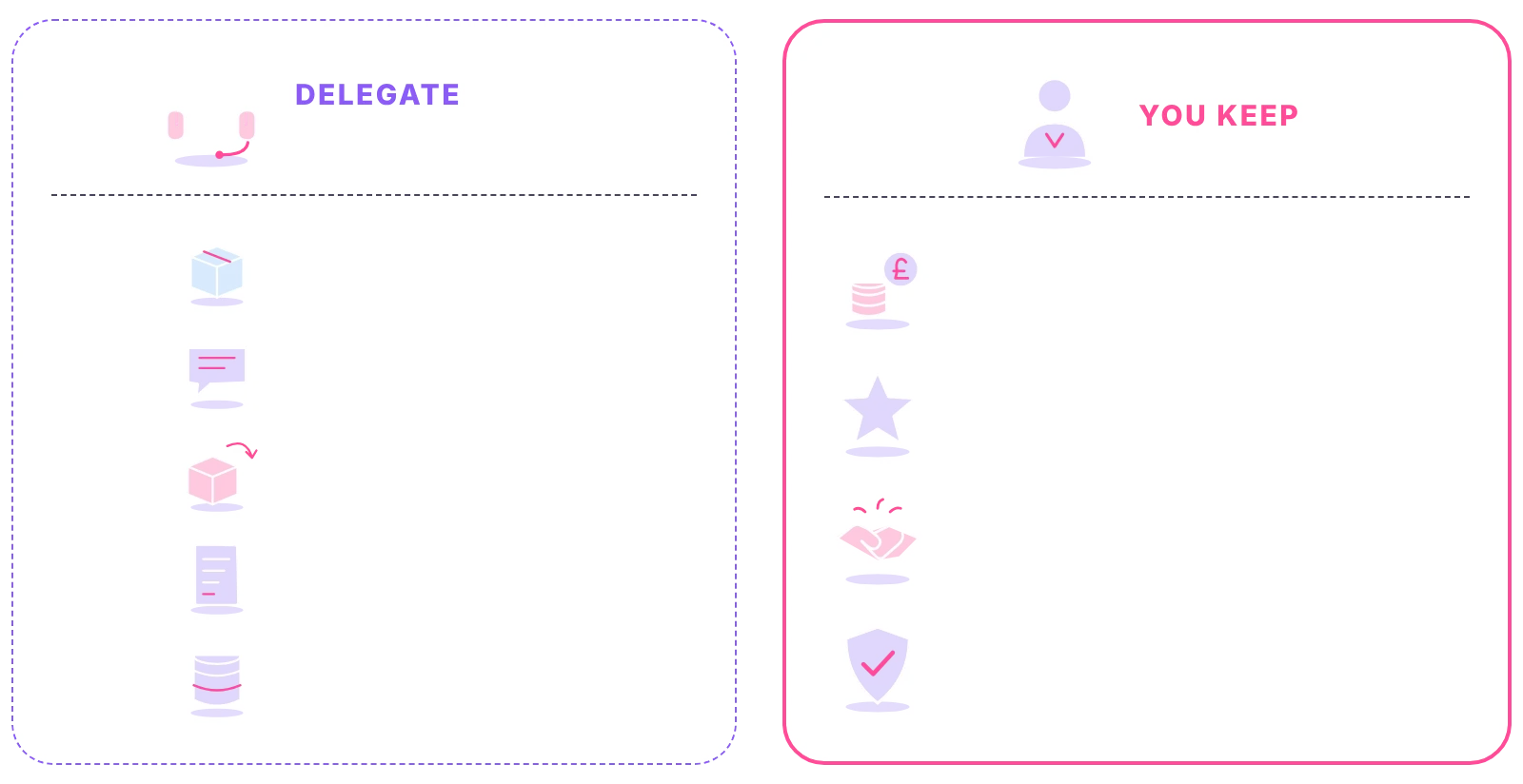
Keep anything with your money in it: prices, discounts beyond the policy, advertising spend, supplier terms and purchase orders above a limit you set. Keep the product decisions: what to stock, what to drop, what to launch. Keep the relationships that expect you personally, your key suppliers and your largest wholesale customers. Keep the account-level decisions on marketplaces, such as responding to a policy action, until your VA has shown you how they handle the routine cases. And keep one weekly review of the numbers, because that review is what keeps the standard once the daily work has left your desk.
Handing over a store task without errors
To hand over a store task without errors, write the policy, grant access at the level the task needs, give one worked example and agree the check-in. Write the policy. For a store, the policy is the rulebook: what a refund needs, when goodwill is allowed, which courier for which order, what a listing must contain. One page per task is enough; if you cannot write it, the task is not ready.
Grant access at the level the task needs. Staff accounts and permissions per task, through a password manager, never a shared login. Every Ant Assist VA signs an NDA and a data-processing agreement, and you can revoke access at any time.
Give one worked example. Process one order, answer one difficult message, handle one return with your VA watching, and say why at each step. The example teaches the judgement the policy cannot.
Agree the check-in. A daily line and a weekly review, and a rule for exceptions: flag it with the context written up, and do not act until told. Read the line; a report nobody reads stops being written.
What delegating store work costs
A managed e-commerce VA from Ant Assist starts at £5 per hour on the entry rate: the first 6 months on the Entry tier, 3 months on Mid, 1 month on Expert. After the promotion, the e-commerce rate card applies: £6.50 per hour full time on the Entry tier (160 hours a month, £1,040) or £6.80 per hour part time (80 hours a month, £544), with Mid at £7.48 and Expert at £8.13 per hour full time for assistants with longer experience. Hours can be scaled up for peak periods and back down afterwards without penalty. There are no platform fees on top, and the rate includes the assistant's time, our office facilities in Cairo, and the supervision and management that keep quality up.

Hours and tier set the price, not the number of tasks. The first five tasks fit a part-time VA for most single-channel stores; all ten across several marketplaces is a full-time role, and the peak season may need more. For the comparison against a UK employee, line by line, read how much a virtual assistant costs in the UK or put your own hours into the calculator.
What the £5/hour entry rate includes
- Dedicated VA, never shared
- UK-hour aligned support
- Management and supervision included
- Recruitment and onboarding included
- Office infrastructure included
- VA replacement available
- No NI, pension, or holiday costs
- 3-month probation, no penalty to leave
Getting e-commerce help from a virtual assistant
You can give this list to an in-house operations hire, to a freelancer, to an agency retainer or to a managed virtual assistant. The in-house route costs a UK salary, employer National Insurance, pension, holiday and a desk, and a fixed headcount is either too small in November or too large in February. A freelancer clears a backlog and leaves with the knowledge of your catalogue. An agency retainer gives you a ticket queue and a rotating team who learn your products every time. Doing nothing has costs too, set out in the cost of not hiring an e-commerce VA.

A managed, dedicated VA gives you one named person who takes the list in the order above, on your hours, for an hourly rate that scales with your seasons, with the recruiting, supervising and replacing handled by the provider. At Ant Assist a UK team supervises quality alongside you, and if the fit is wrong we replace the VA and carry the handover, with no re-recruitment and no restart from zero. For the hiring sequence itself, read how to hire a virtual assistant for e-commerce. For another view of the hire, read how to hire an e-commerce virtual assistant. The ten tasks above are the work an ecommerce VA takes on.



Questions about delegating store work
Didn't find your answer? Browse more common questions in the Help Center.
Hand over the admin. Keep the store.
One dedicated e-commerce VA, from £5 per hour. Book a free 15-minute call.