
How to hire a VA for e-commerce: tasks, skills and cost
Hire an e-commerce VA for real platform experience, not familiarity, and test them on a listing from your own catalogue: store work is judged on accuracy at volume.
Tools our VAs use for this


Hiring a VA for e-commerce comes down to five things:
- The job: listings, orders, stock, reviews, returns and suppliers.
- Skills: real platform experience and listing craft.
- Questions: which tasks they have owned, and in which tools.
- Cost: from £5 per hour at Ant Assist.
- The first 30 days, with platform access set task by task.
For the hiring process step by step, from the store brief to the first live week, see how to hire an e-commerce virtual assistant.
On this page
Store tasks an e-commerce VA takes over
An e-commerce VA takes over store operations across every channel you sell on: listings, orders, inventory, reviews and messages, returns and supplier coordination. Six tasks account for most of it. They are set out in order in e-commerce tasks to delegate. Each of the six is work an e-commerce VA takes off your plate.
Product listings
Creates, updates and optimises listings with titles, descriptions, images and attributes across Shopify, Amazon, eBay and your other marketplaces.
Order processing
Processes orders, tracks fulfilment, handles cancellations, updates shipping statuses and coordinates with couriers.
Inventory monitoring
Watches stock levels across SKUs and channels, triggers reorders before bestsellers run out and flags the slow movers.
Reviews & messages
Responds to customer reviews and marketplace messages on Amazon, eBay and your store, protecting your seller rating.
Returns & exchanges
Processes returns, manages exchanges, handles refunds within your policy and identifies the patterns that reduce return rates.
Supplier coordination
Liaises with manufacturers, freight forwarders, 3PLs and couriers to keep the supply chain moving.
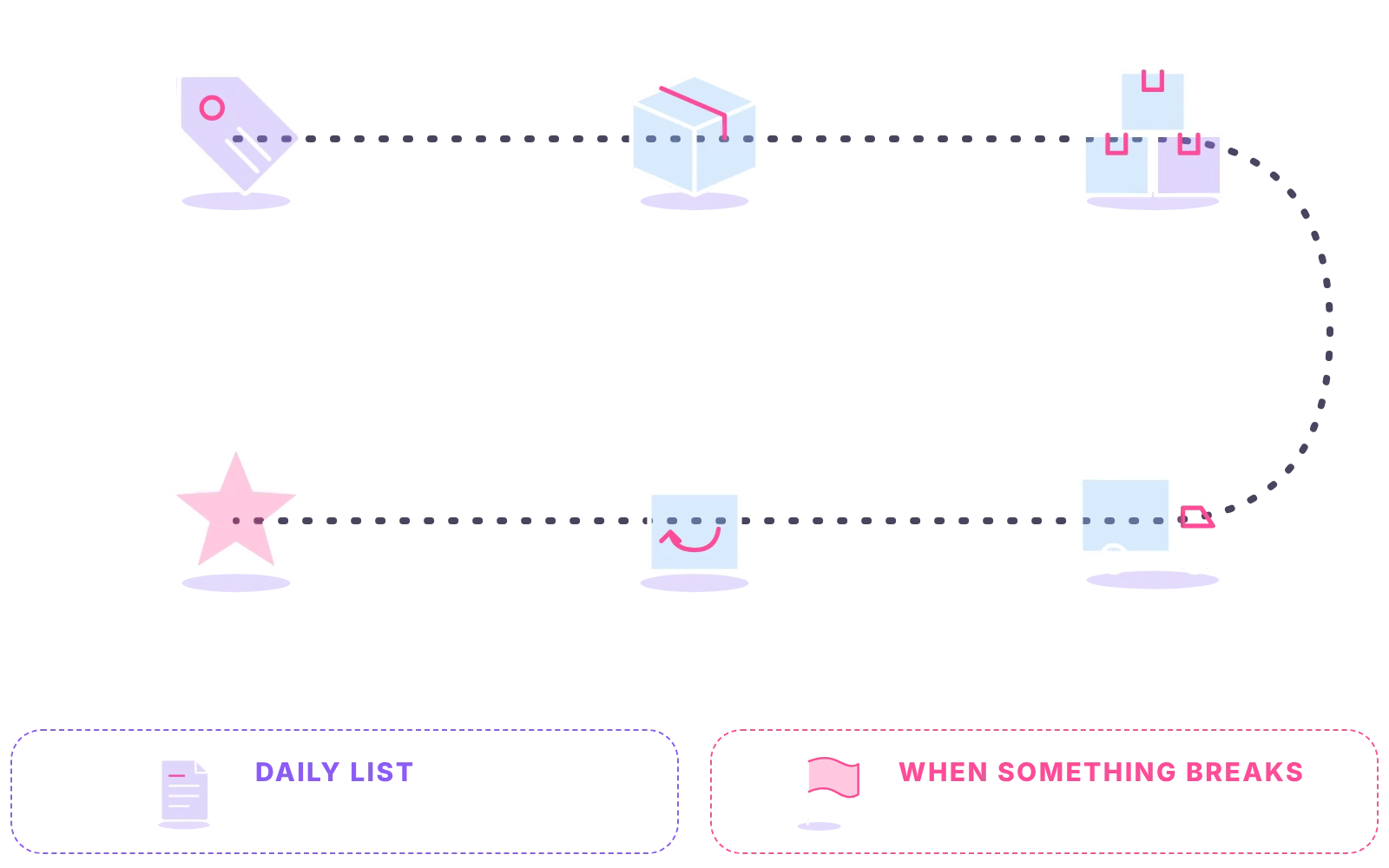
Before you hire, list the channels you sell on, the tasks you do on each every day, and the ones you do only when something breaks. The daily list is the brief. The "when something breaks" list tells you what the VA must be trained to spot and escalate.
Skills and tools to look for in an e-commerce VA
Store operations are judged on accuracy at volume and on never harming the account. Test for both.
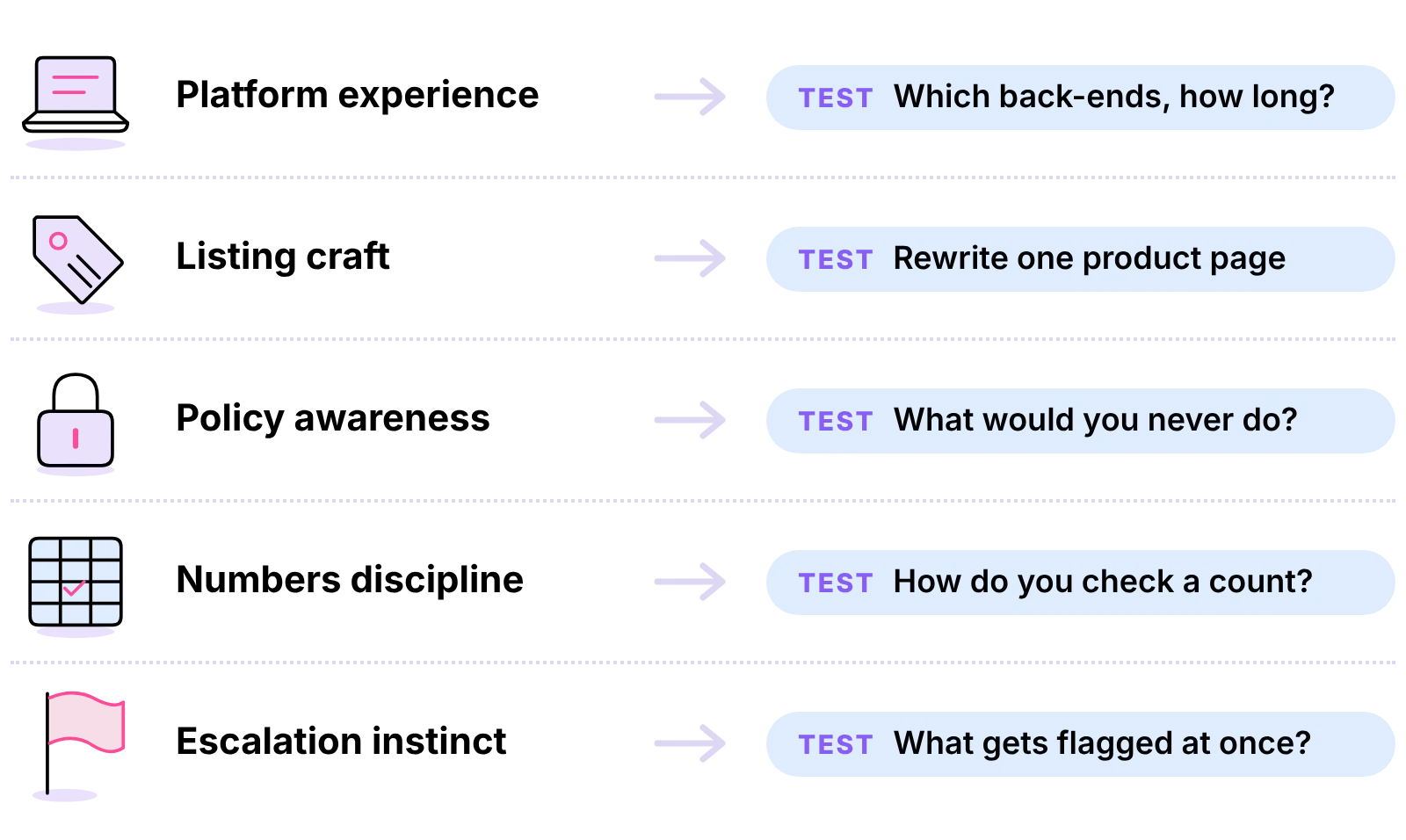
Platform experience, not platform familiarity. Shopify, Amazon Seller Central, eBay, Etsy, WooCommerce and Wix all follow similar patterns, but each has rules that bite. Ask which back-ends a candidate has actually run, for how long, and what task they did most.
Listing craft. Ask for one product page from your catalogue rewritten: title, bullet points, description, backend keywords for Amazon or a full page for Shopify, from your product information and brand guidelines. Read it as a shopper and as a search engine.
Marketplace policy awareness. On Amazon in particular, the wrong reply to a review or the wrong handling of a return can hurt account health. Ask what a candidate would never do in Seller Central and why. A blank look is a no.
Numbers discipline. Stock counts, reorder points, order statuses and refund amounts all have to be right every time. Ask how they check their own work and what they do when a count does not match.
Escalation instinct. A negative review that mentions safety, a supplier delay that will empty a bestseller, a policy warning from a marketplace: the candidate should be able to name what gets flagged to you immediately, without being prompted.
Screening questions for an e-commerce VA
Ask an e-commerce VA which store tasks they have owned and in which tools, how they report their work, what they do at the edge of their scope, and how they handle access and customer data. Four questions, asked of a freelancer, an agency candidate or a managed provider, expose the difference between someone who has run a store and someone who has managed a spreadsheet about one.
Which of these tasks have you owned before, and in which tools?
Ask for the store, the platforms, the order volume and the task mix. Then ask what went wrong: a stock-out, a listing suppressed, a return handled badly. Someone with no such story has not owned store operations through a peak.
How do you report what you did each day or week?
You want a short daily line: orders processed, tickets and messages answered, stock flags raised, listings changed, and anything waiting on you. A good answer names the format and the time. A vague one means you will be back inside Seller Central checking.
What happens when something is outside your scope?
In e-commerce the edge of scope is a refund outside policy, a customer threatening a chargeback, a supplier asking for a decision, or a marketplace notice. The right answer is a rule: flag it immediately with the context written up, and do not act until told.
How do you handle access, passwords and customer data?
Store VAs see order histories, addresses and sometimes payment tools. Listen for a password manager, for comfort with an NDA and a data-processing agreement, and for the understanding that platform access is granted at the level the job needs and can be revoked at any time.
If you are hiring through a managed provider, ask the provider the same four questions about the assistant they propose, with the assistant's name attached. For hiring in general, read our VA hiring guide.
What an e-commerce VA costs
An e-commerce VA's price depends on the hiring model more than the task, from a UK salary with employment costs to a managed VA's hourly rate. A UK-based operations hire, employed or through an agency, costs what a UK salary costs plus employer National Insurance, pension, holiday, a desk and your management time, and seasonal peaks make a fixed headcount either too small in November or too large in February. A freelancer's hourly rate looks lower until you add the hours you spend recruiting, briefing and covering their absences during your busiest weeks. The other side of the sum is the cost of not hiring an e-commerce VA.
A managed e-commerce VA from Ant Assist starts at £5 per hour on the entry rate: the first 6 months on the Entry tier, 3 months on Mid, 1 month on Expert. After the promotion, the e-commerce rate card applies: £6.50 per hour full time on the Entry tier (160 hours a month, £1,040) or £6.80 per hour part time (80 hours a month, £544), with Mid at £7.48 and Expert at £8.13 per hour full time for assistants with longer experience. Hours can be scaled up for peak periods and back down afterwards without penalty. There are no platform fees on top, and the rate includes the assistant's time, our office facilities in Cairo, and the supervision and management that keep quality up. For the comparison against a UK employee, line by line, read how much a virtual assistant costs in the UK or put your own hours into the calculator.
What the £5/hour entry rate includes
- Dedicated VA, never shared
- UK-hour aligned support
- Management and supervision included
- Recruitment and onboarding included
- Office infrastructure included
- VA replacement available
- No NI, pension, or holiday costs
- 3-month probation, no penalty to leave
The first month with an e-commerce VA
The first four weeks decide whether the store runs without you.

Before day one. Grant platform access at the level each task needs, through a password manager, never by sharing credentials in a message. Write down your policies on returns, refunds and replacements, your reorder points for the top sellers, your brand voice for reviews and messages, and the short list of things that always come to you.
Week one: shadow and listings. Your VA learns the catalogue, the channels and the daily rhythm, and starts on the lowest-risk work: listing updates and image and attribute fixes that you approve before they go live. The output of the week is a shared document of your standard operating procedures as they actually are.
Week two: orders and messages under review. Orders are processed and statuses updated with you checking a sample. Customer messages and reviews are answered from your voice guide, with anything sensitive drafted for your approval. The daily line starts and you read it.
Weeks three and four: ownership. Order processing, stock monitoring, routine messages and in-policy returns run without review. Reorder flags arrive before the stock-out, not after. Supplier and courier chasing is theirs. You keep one weekly review slot for the numbers and the escalations, and you start planning peak-season cover a few weeks ahead so the hours are in place when the orders arrive.
At Ant Assist a UK team supervises quality alongside you throughout, reviews the work with your VA, and scales hours with your seasons. If the fit is wrong, we replace the VA and carry the handover, with no re-recruitment and no restart from zero. A managed VA is one form of outsourced e-commerce support for online stores.



E-commerce VA hiring questions
Didn't find your answer? Browse more common questions in the Help Center.
Run the store without running yourself down.
One dedicated e-commerce VA, from £5 per hour. Book a free 15-minute call.