
Virtual assistant vs personal assistant: which do you need?
Personal assistant describes the work; virtual describes where it is done. Most owner-managers need a PA, and since their work happens on a screen, a virtual PA usually fits.
Tools our VAs use for this


Personal assistant describes the work; virtual describes where it is done. Which you need depends on the work:
| Title | What it means |
|---|---|
| Personal assistant | One person to run your inbox, diary, travel and expenses, in your office or remotely as a virtual PA |
| Virtual assistant | Support for a business function: customer service, lead generation or e-commerce admin |
Most owner-managers who search this comparison need a PA, and for most of them a dedicated virtual PA is the better-value version of it. Ant Assist provides one from £5 per hour on the entry rate. If the work is general admin rather than one person's week, an admin virtual assistant may fit better.
On this page
Defining virtual and personal assistants
A personal assistant supports one person's working week, while a virtual assistant is any assistant who works remotely, whatever the work they do. A personal assistant works for one person. The job is that person's working week: inbox triage, calendar management, travel booking, document and note preparation, expense tracking, and the supplier and vendor coordination that would otherwise interrupt them. The PA's customer is the individual, and the measure of the job is whether that individual's time is spent on what only they can do.
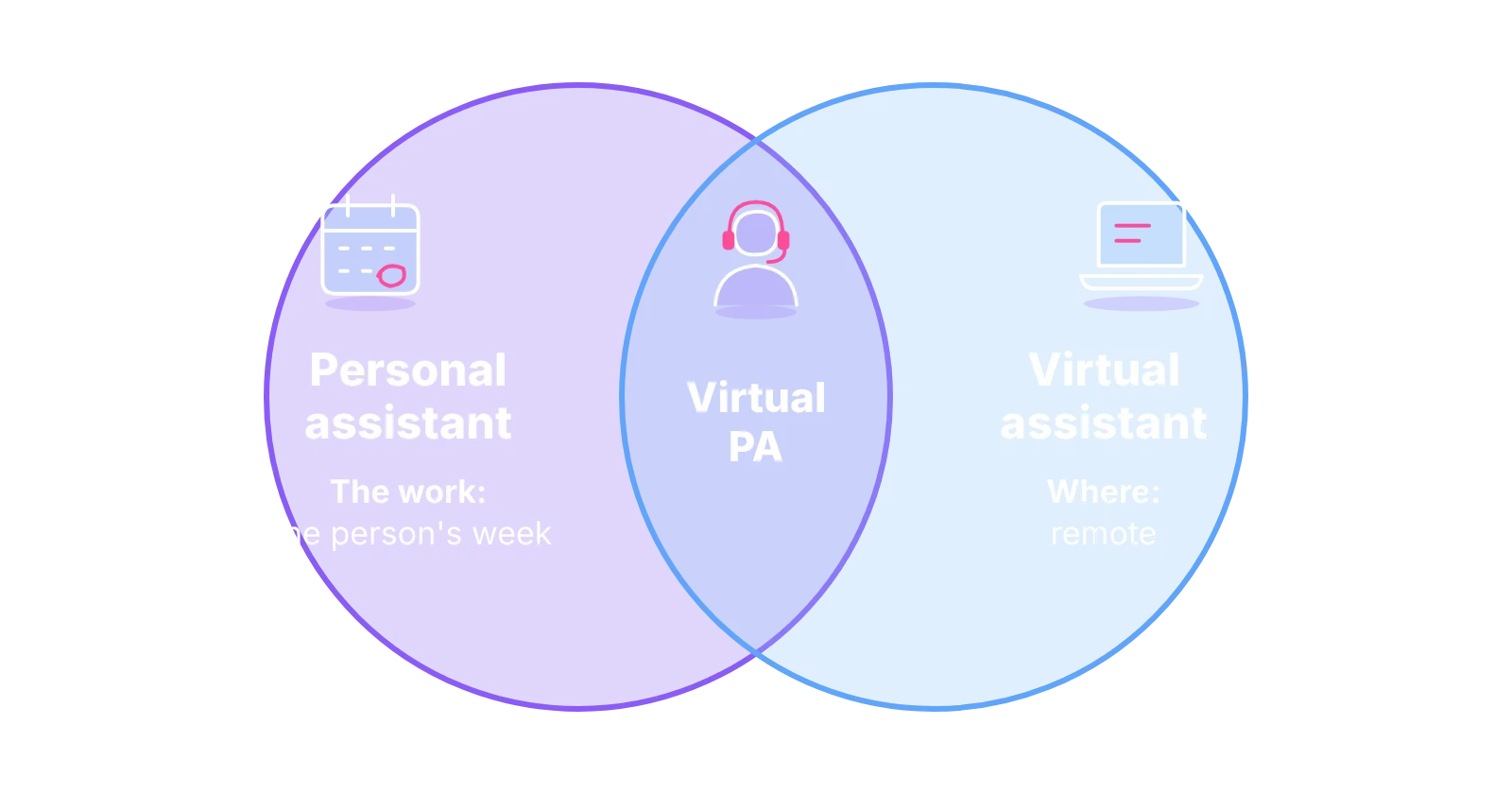
A virtual assistant is any assistant who works remotely rather than in your office. The term says nothing about the work. A virtual assistant might be a PA, an administrative assistant for a whole team, a customer service agent answering your tickets and live chat, a lead generation assistant building lists and booking discovery calls, or an e-commerce assistant maintaining your listings and processing orders. Read what a virtual assistant does for the four families of work.
So the comparison people are actually making is between an in-house PA and a remote assistant, and the honest answer depends on whether the work needs someone physically present.
Key differences between a VA and a PA
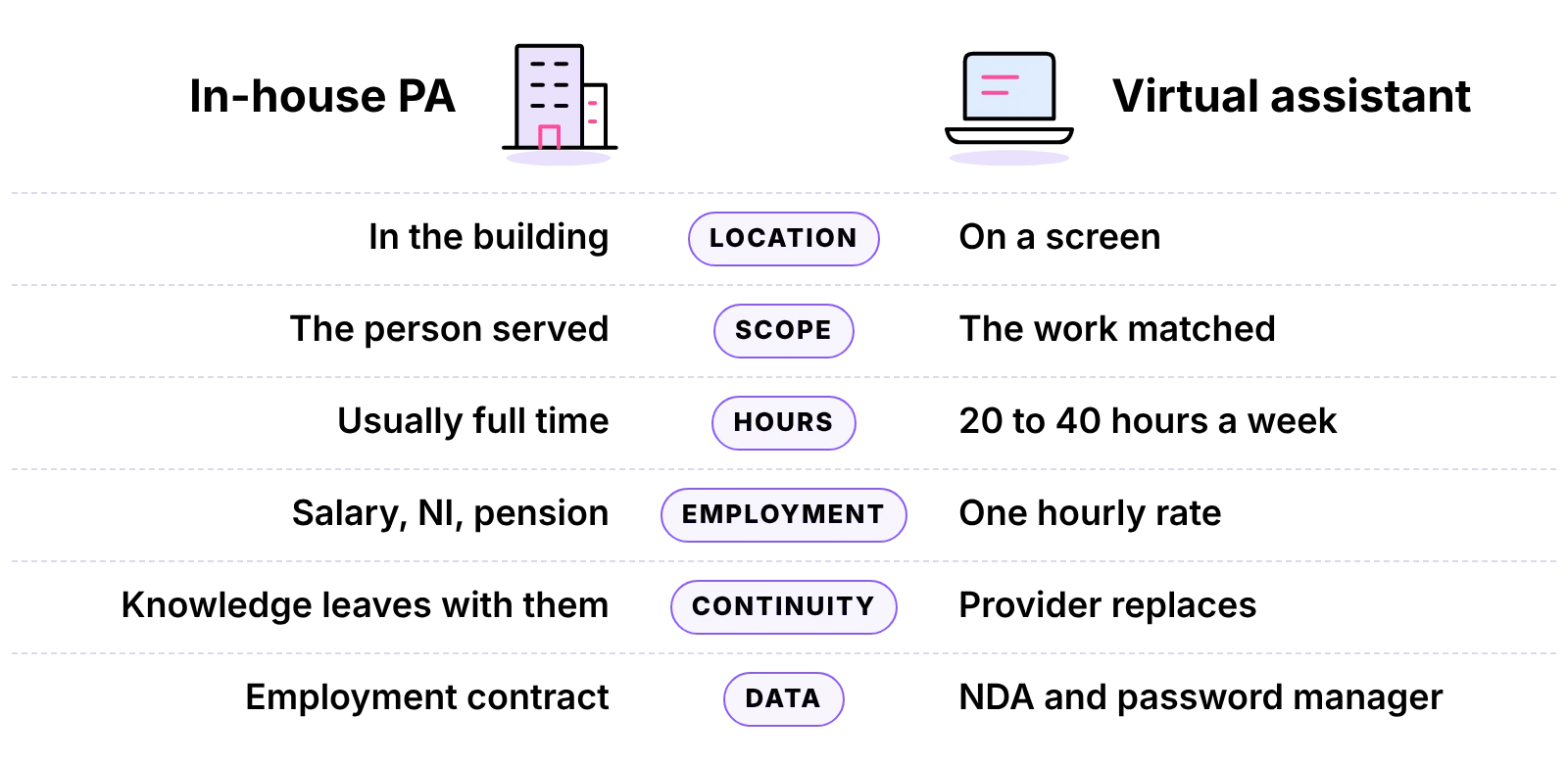
An in-house PA is an employee in your building who serves one person, while a virtual assistant works remotely, by the hour, on anything done on a screen or phone. Location and presence. An in-house PA is in the building: they can greet visitors, sit in meetings, handle paper and physical post, and read the room. A virtual assistant does everything that happens on a screen or a phone, which for most owner-managers is almost all of it, and nothing that needs a body in the office.
Scope. A PA is defined by the person they serve. A virtual assistant is defined by the work they are matched to. A virtual PA is both: one person, remote, running your working life.
Hours. A PA is usually full time because they are employed. A virtual assistant is hired by the hour, from 20 hours a week to a full 40-hour dedicated assistant, on UK business hours.
Employment model. An in-house PA is an employee, with a UK salary, employer National Insurance, pension, holiday, a desk and the recruitment when they leave. A virtual assistant through a managed provider is one hourly rate, with recruitment, supervision, office and replacement included. The initial term is 12 months, including a 3-month probation in which you can end the engagement without penalty. After 12 months it continues monthly with 30 days' notice.
Continuity. An employed PA leaves when they leave, and the knowledge goes with them until you recruit again. A managed provider replaces a dedicated VA and carries the handover, so the role continues even if the person changes.
Data and access. Both need access to your inbox, your calendar and often your finances. With an employee that trust sits inside an employment contract; with a managed VA it sits inside an NDA, a data-processing agreement and a password manager you control, with access you can revoke at any time.
When an in-office PA is the better choice
An in-office PA is the better choice when you need someone present: to host visitors, run a front desk, manage physical documents and post, or sit in on meetings. Senior executives with heavy in-person schedules often fall into this group. The cost is the full cost of a UK employee, and the recruitment is yours, but the presence is the point and nothing remote replaces it. Senior leaders can read whether a virtual executive assistant is worth it.
When a virtual assistant is the better choice
A virtual assistant is the better choice when your working life happens on a screen. The inbox, the diary, the travel, the expenses, the supplier emails and the documents are the problem, and none of them needs someone in the room. You want the support by the hour, on your hours, without adding an employee, and you want to be able to change the hours as the business changes. That is the case for a virtual assistant, and if the work is your own working week rather than a business function, specifically for a virtual PA. If the inbox is most of it, the inbox management virtual assistant page describes that specialist version.
The virtual PA role
A dedicated virtual PA takes the PA job as it is, inbox to expenses, and does it remotely. At Ant Assist the virtual personal assistant UK page describes the role: one named person, matched to you, working your hours from our managed office in Cairo, with a UK team supervising quality. Your PA is trained on your tools and your ways of working during onboarding, works inside your accounts through a password manager, and can be replaced without restart cost if the fit is wrong. It is the personal-assistant half of our admin service, and it is what most people comparing these two terms turn out to need.
Virtual PA costs
A managed admin VA from Ant Assist starts at £5 per hour on the entry rate: the first 6 months on the Entry tier, 3 months on Mid, 1 month on Expert. After the promotion, the admin rate card applies: £6.30 per hour full time on the Entry tier (160 hours a month, £1,008) or £6.50 per hour part time (80 hours a month, £520), with Mid at £7.25 and Expert at £7.88 per hour full time for assistants with longer experience. The rate includes the assistant's time, our office facilities in Cairo, and the supervision and management that keep quality up; there are no platform fees on top.

Hours and tier set the price. A part-time virtual PA covers the inbox and the diary for most owner-managers; full time makes sense when travel, expenses, documents and suppliers are on the list too. Set that against a UK in-house PA once salary, employer National Insurance, pension, holiday and a desk are counted: read how much a virtual assistant costs in the UK or put your own hours into the calculator.
What the £5/hour entry rate includes
- Dedicated VA, never shared
- UK-hour aligned support
- Management and supervision included
- Recruitment and onboarding included
- Office infrastructure included
- VA replacement available
- No NI, pension, or holiday costs
- 3-month probation, no penalty to leave
Getting PA support from a virtual assistant
A virtual assistant fits wherever the work is on a screen and the need is for hours rather than a headcount. It does not fit where presence is the job. Between those two cases sits a middle ground: owners who assumed they needed someone in the office because that is what a PA has always meant, and who find, once the diary and the inbox are running without them, that the office part was never the point.
At Ant Assist a UK team supervises quality alongside you, reviews the work with your VA, and adjusts hours and scope as your business changes. If you are unsure which you need, tell us how your week runs on the first call and we will say which fits, including if the answer is an in-house hire. If remote fits, you can hire an admin VA on the hours you need.



VA and PA FAQs
Didn't find your answer? Browse more common questions in the Help Center.
Get a PA without the payroll.
One dedicated virtual PA, from £5 per hour. Book a free 15-minute call.